Lessons For Sale: A New Marketplace for Teachers

school-supplies

Get the full story on the Texas Standard

Think of it as Etsy for educators. That’s how CEO Adam Freed says some people describe it.

“You can buy so much on Teachers Pay Teachers,” Freed says. “You can find worksheets and activities that are supplementary curriculum…. You can find supplies you’d use in your classroom like cool posters or new ways to tag books for different levels of readers in your classroom,” he says.

Teaching has always been more of a challenge than most non-teachers realize. San Antonio first grade teacher Reagan Tunstall says with state and district requirements changing almost every year, teachers feel endless pressure to keep their material fresh.

“All of the extra things that we need to do – planning for the next week – all happen in the evenings and it takes away that precious family time,” Tunstall says. “So, I think when the state changes things – which they often do…it’s more of a time stealer. We’re planning what we’re doing next and when things are unfamiliar it just takes longer to make sure that we’re hitting all of those objectives and expectations for every student. So, it can be very difficult especially when the year is in full swing and we’re already filling that time crunch.”

Tunstall says she thought ‘I should be compensated for this work.’ She says it was frustrating that all the work that went into planning was used just once.

“In the end, I upload everything. The basic idea is that it’s based on about 10 cents a page but really it kind of depends on the content and the time spent. As a teacher I know budgets are tight so I try to price it very affordably,” Tunstall explains. “Just knowing that other teachers are using it is a huge, just amazing fulfilling feeling, so that’s really what I get out of it.”

If a student buys an essay online, it’s considered cheating. But fourth grade teacher Nina Gufstason says buying lesson plans online isn’t cutting corners.

“It’s definitely different, because you are paying for someone’s ideas,” she says. “I think you’re working smarter not harder. And I think that is where teachers need to move – is to work with each other and not just depend on having to do everything themselves.”

Gufstason says the days are long, she gets to school at 7:15 a.m. and leaves around 7:15 p.m. And the lesson plans are not the only thing on her plate.

“The number one thing is my students and making sure that they’re, you know, taken care of and they’re learning and they’re having fun,” she says. “And so if I can use other people’s great ideas and make that happen, that’s what I should do.”

Gustafson says being a fourth grade teacher comes with a lot of challenges, long hours, rowdy kids, and big messes. But the best part, she says, is knowing that other teachers have your back.
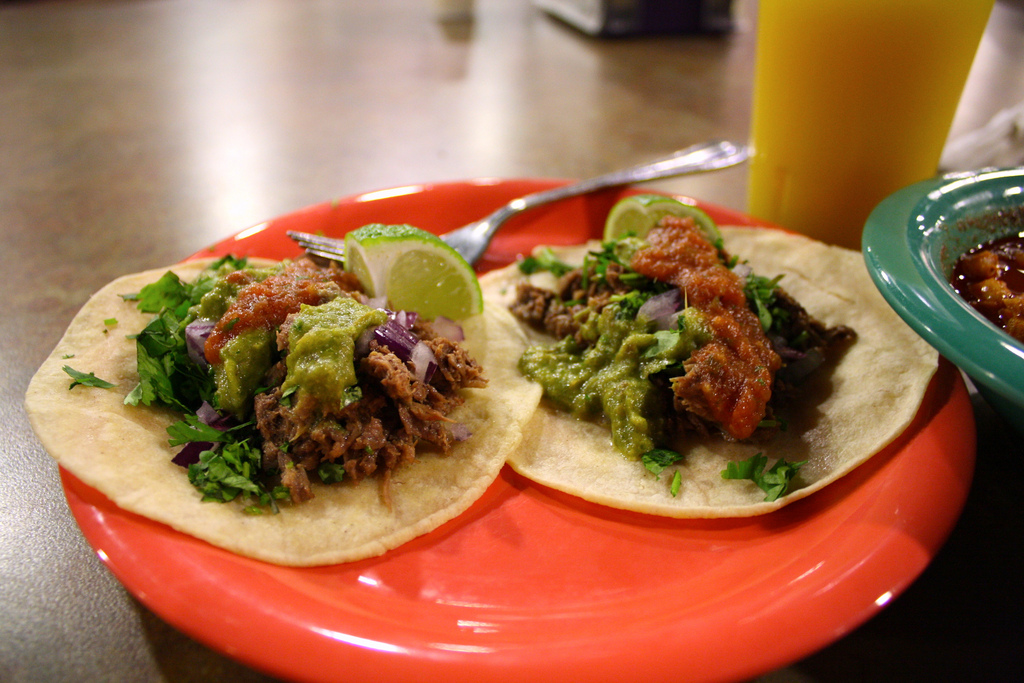
You Don’t Need Eggs To Make a Breakfast Taco

4188956731_eb729ec537_bGet the full story on the Texas Standard

You’ve seen the headlines this month: “America’s Egg Shortage Threatens Austin’s Breakfast Taco Supply”, “Austin Restaurants Respond To National Egg Crisis”.

But – wait a minute. We need to think through this clearly. Deep breaths.

Not having eggs in your tacos isn’t a tragedy; this is an opportunity to branch out of your comfort zone. That’s what Mando Rayo says – he’s the author of a book called “Austin Breakfast Tacos.” He stopped by the Texas Standard to put us at ease.

On restaurants charging extra for eggs:

“Yes that is true, they are charging just a little bit extra delivery free of the egg from the chicken. As well as limiting their hours of operation for breakfast, which is a tragedy in Austin because in Austin if you wake up at 7 in the morning, at 2 in the afternoon, or 5 o’clock you need your breakfast taco.”

On alternatives for eggs in breakfast tacos:

“The breakfast taco you know Mexicans been eating tacos before Texas was Texas. Breakfast tacos not always comes with egg. Anything outside eggs like barbacoa, picadillo like ground beef with potatoes and some pico de gallo with some spices; lots of pepper. Also carne guisada, which is stewed meat and gravy. You can do cactus but that usually goes really well with eggs. Avocado and bean taco with just a little bit of cheese is delicious!”

On whether a breakfast taco is truly a breakfast taco without eggs:

“I laugh in your face! Abuelita’s have been making breakfast tacos without eggs. As soon as that part of frijoles was done, refried with a little bit of butter, that’s a breakfast taco!”


In your opinion, do breakfast tacos need eggs? Tweet @TexasStandard using #NotAllTacos and tell us what you think!

Does Your Water Bottle Really Need to be ‘Smart?’

waterbottleGet the full story on the Texas Standard

Imagine a world where you could count every sip of water you took – and your boss could see it too. That’s the idea behind brothers Jac and Davis Saltzgiver’s new invention, Trago.

“We allow coaches and teams or even parents to monitor an entire groups of people with multiple bottles so a coach or trainer could make sure their entire team is well hydrated before a game,” Davis Saltzgiver says.

I had to ask Jac Saltzgiver the obvious question.

“Thirst that is good for most people especially people that are really in tune with listening to their body and the way we feel but many of us aren’t very good at that essentially,” Jac Saltzgiver says. “We are working out, we’re always on the go, we’re working really hard and long hours and we don’t really take the time to step back and really kinda realize hey I should be drinking water now or this is how much I should be drinking after I train and Texas heat you know after a long run that day.”

The tracker is for serious athletes, maybe not for joggers or weekend warriors. But the more than two dozen fitness trackers out there are marketed to the everyman.

Austin-based Map My Fitness was acquired by Under Armour this year, now the company says it will hire one hundred tech workers in downtown office.

“It really makes Austin a great place to start a company like this that really will plug into those platforms that are already tracking people’s workouts,” Jac Saltzgiver says. “Those are platforms like Map My Fitness and MyFitnessPal and in Europe the big one is Endomondo. And right now all three of those sit under the Under Armor umbrella.”

But tracking our sleep, our calories, our steps and now our water, Professor Prabhudev Konana at the University of Texas’ McCombs School of Business says it might all be too much.

“Do you really need it in real life? The body reacts to not having water. My take has always been if it can provide you some feedback that is useful to the people so be it. A small segment that says this kind of notification is cool,” he says. “Whether I use it or not – that’s a different thing. It’s cool so I’m going to buy it.”

Konana says the reason gameification is a buzzword is because it’s effective. Take Fitbit.

“I walk around but I never paid attention. But sometimes you keep working and suddenly it beeps you, you’ve been sitting for so long -get up,” he says. “Believe it not my reaction is: I wake up, I get up.”

Konana says real test of whether the market has been over-saturated with fitness trackers is whether people keep them. Tech analyst group Parks Associates predicts the fitness tracker industry will be worth $5.4 billion by 2019. We’ll have to see if the demand matches the hype.

Texas Budget Winners and Losers of 2015

8267333840_9e8678b8b2_k

Get the full story on the Texas Standard

Border Spending

“The border funding was substantially increased, this time we ended up giving about $800 million to the border for border security, and I think that’s almost more than $300 million [more] than we did the last session.” — Rep. Sylvester Turner from Houston (D)

Medicaid Spending

Eva de Luna Castro, budget analyst at the Center for Public Policy Priorities, says the $61 billion legislators budgeted for the next two years of Medicaid almost certainly won’t be enough. “What basically happened was the full amount of cost for Medicaid isn’t in this budget that they passed–they left medical inflation out, so that’s like assuming that your rent isn’t going to go up in this year. You know it probably will be, but you just aren’t going to deal with it right now.”

Correctional Officers

Turner says they were big winners. “They received a pay boost of 8.8 percent,” he says. “That was certainly needed, because the prison system has been facing a vacancy rate of anywhere between 3,000 to 3,500 correctional officers mainly because we have not been able to compete with the private sector.”

Transportation

Dale Craymer, president of the Texas Taxpayers and Research Association, says the legislature funded the Department of Public Safety with general revenue and left gasoline tax revenues for the Department of Transportation to maintain the roads. But…

“…Well, I mean, it’s an additional $1 billion a year in roads which is a good thing, however TxDOT estimates they need anywhere from $3 to $5 million additional each year just to maintain the current level of congestion.”

Tax Cuts
It’s a mixed bag depending on who you ask.

“Tax cuts will have a good impact,” Craymer says. “Puts more money in people’s pockets that helps stimulate the economy.”

But de Luna says the cuts are a bad thing. “If you looked at where the tax cuts—where the benefit goes—the franchise tax, for example, was about $2.6 billion of that roughly $4 billion in tax cuts that the legislature made,” de Luna says. “A third of that franchise tax cut goes to out-of-state. It doesn’t even help companies here in Texas.”

The Way We Board Planes Is Inefficient – But It’s Not Changing

2733800947_c36b4970dc_b

Get the full story on the Texas Standard.

If you’re traveling soon, you know the drill.  You arrive at the airport, kick your shoes off, pass the security checkpoint, sit at the terminal, wait for the flight attendant to finally call your boarding zone…wait, what’s your boarding zone again?

And when the attendant finally scans your ticket, you’re stuck in a line at the boarding bridge with dozens of other frustrated people, waiting to finally sit down. Mathematician Jason Steffan was in that familiar situation, but unlike the rest of us, he thought he could actually fix it.

“I work primarily in exoplanets studying planets that are orbiting distant stars,” Steffan says.

He used the same model he uses to measure the chaos of the universe to find a system of boarding a plane that would be less chaotic.

“So what you want to do is you want to spread the passengers out all throughout the interior of the airplane so that everyone can put their luggage away at the same time and sit down at the same time,” he explains. “The best way to do that is to have passengers that are next to each other in line be separated by two rows in the airplane itself.”

Steffan says the way we get on a plane now is actually not any quicker than seating people at random.

Bernie Leighton writes for Airline Reporter. He says while boarding groups may not be the quickest way to get hundreds of people into a flying tin can, it is the best way for airlines to get them to pay extra for a premium seat.

“People have hidden preferences and overt preferences when they’re making their choice, so they might say ‘I would like to board the fastest’ but if that ticket is $20 or $30 dollars more they’ll say ‘You know, I can suck it up and then complain later,’” Leighton says. “It’s one of the quirks of the airline business that I think most of us, as both passengers and industry insiders, have just come to groan about.”

Leighton says short of the airplanes becoming shaped like triangles, you’re going to have to arrive at the gate 30 minutes before departure time.

But next time you take off to a far-off destination and you overhear the person in front of you asking why boarding a plane is the absolute worst, you’ll have something to talk about.

Could Texas Ever Pass Canada’s No Tampon Sales Tax Law?

tampons

Get the full story on the Texas Standard

No taxation with menstruation – that’s what 75,000 Canadians said in a petition to lobby the federal government to remove sales tax from feminine hygiene products. Jill Pieback led the movement from Toronto.

“We launched a campaign on January 26th with a goal of getting 50,000 signatures,” she says.

Along the way, they had a problem familiar to many women’s rights activists.

“The problem that we were facing in Canada is that there is no gender parity in our government,” Pieback says. “And this tax was so symbolic of so many other laws in Canada that have been made without considering women in this country.”

The petition was successful. The country’s government approved the tax exemption in a unanimous vote. In Texas, the state collects more than half a million dollars from taxes on feminine hygiene product every year. Steve Hanabutt is the president of Sales Tax Specialists in Plano.

“Currently the law says that any over the counter drugs that is required to be labeled with a drugs facts panel is going to be exempt from sales tax,” he says.

That means contact solution, laxatives and painkillers are exempt. Not to mention, groceries. Ann Dunkleburg is an associate director at the Center for Public Policy Priorities in Austin.

“That comes very close to having the same rationale or even food for the reasons that you wouldn’t want to put a sales tax on it,” Dunkleburg says. “But because of the sort of ‘good old boy’ nature of our history here, those things have never been considered for exemption before.”

So will Texas ever pass a law like Canada – lifting what some have called a ‘tampon tax?’

“I think, that it could eventually and it probably will eventually, but frankly it might not be the highest priority,” she says. “I think you know we had a hard time getting some important legislation about the ability of state employees to express milk at work or breastfeed, so it’s not as easy despite the fact that in 2015 we would think these things would be easier to do.”

Some activists are wondering if it might actually be easier to lobby feminine hygiene companies to sell kits – say a box of pads or tampons along with a bottle of pain reliever. If it has to have medical ingredients listed on the box, it would be tax exempt in the state of Texas.

Online Personal Stylist Company Comes To Image-Conscious Dallas

16407740_5e5f7ba1e4_b

Get the full story on the Texas Standard

Being able to shop in your pajamas from the comfort of your living room was supposed to fix all the problems with brick and mortar shopping. Shoppers Avery Heldenfels, Catherine Albrecht and Kelsey Butt talk about their hangups:

“You, I guess you have to get out and go, and find parking, sometimes that’s hard depending on where you go, they can be busy and they don’t always have your size,” Heldenfels says.

“If it’s crowded and also if the salespeople are constantly hounding you then it takes away from the whole aspect of it.” Albrecht says.

“You waste just a whole day sometimes if you’re looking for something specific, so that drives me nuts,” Butt says.

But, these shoppers tell me that online shopping creates its own headaches.

“Online is always difficult because sometimes things look like they’re better quality online or they’re going to fit a certain way and then you get them and they don’t,” Butt says.

“Online, definitely paying for shipping, not being able try on the clothes, not seeing what they look like in person,” Heldenfels says.

While it’s not a life or death problem, Silicon Valley entrepreneur Katrina Lake thought it was one she could solve. And if she could combine the best parts of online shopping with your local mall, she could make a lot of money.

“Part of the ‘a-ha’ moment was when you go into a store you can say like I want something I look awesome on a first date or something like that and it’s so hard to do that in e-commerce,” Lake says. “So you can search for the cheapest black dress or the black dress that’s going to ship to you the fastest, but it’s so hard to be able to say which one am I going to look best in or which black dress is best for me.”

She created a company called Stitch Fix, it’s a personal stylist service that sends you five items of clothing a month chosen just for you. You buy what you keep, and each item costs $50. The service is designed for women who like clothes but are too busy to shop.

That sounds just like everyone Alli Finney knows – she’s a fashion editor at D Magazine in Dallas.

“I definitely think we have a huge executive industry here and we have a lot of women that want to look good,” Finney says. “And I definitely think it’s because the city has a pulse on what’s happening and has a pulse on what’s new and trending and I think we definitely take advantage of that in every way that we can.”

That might be why the company picked Dallas for its third national distribution center.

“Texas is important to us for a couple of reasons,” Lake says. “First and foremost we have many many clients in Texas, and so our Dallas distribution center will serve the vast majority of our clients in Texas, and it’s great to be able to have stylists who are local and who understand Texas culture and what people are looking for.”

The company will hire up to 500 people for the Texas jobs, and, depending on interest, might expand into other image-conscious Texas cities.

It’s not clear whether Stitch Fix is turning a profit, but in its last round of seed funding, investors valued it at over $300 million.

Dress-Over-Pants Fashion Crazy Nothing New: It’s Pakistani

7287753822_0b08bfba50_k-2

Get the full story on the Texas Standard.

Commentator and Houston Fashion Designer Sameera Faridi says the hot trend that A list celebrities are wearing this summer is a trend that you’ve been able to see in Houston’s Pakistani neighborhoods for years.

For the fashion bloggers that are not aware, Faridi says Pakistani women have been rocking the dress-over-pants look long before A-list celebrities like Sarah Jessica Parker layered up.

“We’re actually very excited to see this amazing trend catching up…this is going to be the look for the summer. It’s a very particular cut of the top and the pants,” Faridi says. “It’s really nice to see how simple the cut is, yet it is actually a derivative of a dress from another culture.”

Girls Summer Camp In Texas To Open Despite Recent Flooding

Photo_10_2067374_Salinas_Camp_Flood.2 versions of this story, one for the Texas Standard and one for NPR

http://www.npr.org/player/embed/411660209/411660213

This Sunday, 150 girls ages 6-16 will say goodbye to their parents, grab their trunks, and move into their summer cabins at Rocky River Ranch. The 50-year-old camp is a place preserved in time. When alumni drop off their little sisters and daughters, director Shanna Watson asks them if anything looks different.

“I always like to ask that question to alumni that come because we’ve done a lot of work but always in the effort to keep it the same,” she says.

But after the Memorial Day floods, the camp’s riverbank is unrecognizable. Dozens of giant sycamore trees are turned on their sides, rocks and debris from houses upstream litter the once pristine view. And the view is not the only thing the camp lost.

“We had moved all of our kayaks up here because that’s what we do when it’s gonna flood and they’re usually safe up here on this hill, and we had like a storage shed that had our paddles and our life jackets and all of our rappelling equipment and like the whole shed is gone, not like a little rubber maid, it was a real wooden shed,” Watson explains.

Counselor Maddie Hammil and her coworkers are brainstorming how they’ll make up for not being able to use the river this year.

“It’s going to be pretty hard but we’re just going to have to explain that camp is going to be a little different this year,” Hammil says. “Just like we rotate through some of the programs we do in the evenings – we’re going to have to rotate through some of the classes, including classes up at the pool, so they’ll still be able to get in the water if that’s what they have their hearts set on, and like a ton of other beautiful places on camp.

Meanwhile, volunteers are busy chopping up the dead trees and separating the brush from the debris. Bailey Rainey is clearing the way for a new campfire.

“So campfire is how we end each session here at camp,” Rainey says. “It’s always been the perfect view of the river, and the rocks, it’s almost a sacred place on camp, so I feel blessed to be able to clean the area that’s going to be that place again because the old one is not so much there anymore.”

Director Shanna Watson says even though the river is now swollen, dangerous and will be off-limits, so far, they’ve had no cancellations

“What our hope is that they will realize you know camp is amazing no matter what activities you’re doing,” Watson says. “You know the activities are a tool for the bigger part of camp, that’s what we’re going to focus on, the relationships and growing independent girls and we feel comfortable we can do that, even without the river activities.”

The goal is for the girls to love camp anyway. That way they’ll come back next year and experience the river the way their moms and sisters did before them.

Texas Has A Retirement Home for Pets

4848281540_d5e2a5727a_bGet the full story on the Texas Standard

If you go to the Stevenson Companion Animal Life Care Center at Texas A&M, you’ll be greeted by a posse of dogs. Their queen bee, a 10 year old Boston Terrier named Patty. She has short little legs and an irresistibly smooshed face. She was running in circles around my legs.

I could tell Patty had something to tell me about her pet retirement, but I needed an interpreter, vet technician Janet Broadhead:

“Well she didn’t have much say so in the matter and she really liked her daddy because he took her everywhere it seems like especially drive thrus and only fed her people food so when she came here she didn’t really like it too much because she had to eat dog food and she had different handlers,” Broadhead says. “And then as time went on she’s learned to really like it and adjust to all the different people and the routine just like everyone else, I think she’d really say she really likes it now.”

The Stevenson Center runs on kibble and routine – you have to have a strict schedule to take care of the 34 animals at the center: dogs, cats and even a llama. Assistant Director Ellie Greenbaum says was started by Dr. Ned Ellet in 1993.

“He was the head of the small animal clinic here at the college of veterinary medicine for many years and he wanted someplace for people who didn’t’ have family of friends that could or would care for their pets,” Greenbaum says. “He wanted to create a home-like environment where they could send their pets and it would benefit the pets and the college of veterinary medicine.”

To enroll Patty in the program, her owner left her an endowment of at least 50 thousand dollars. Unlike a shelter that would try to get her adopted, Patty will stay at this sanctuary for the rest of her life, being cared for by people like Lauren Schwerdfeger.

“Patty is a hoot, she definitely has some character,” she says.

When the 9-to-5 staff goes home,Schwerdfeger and three other veterinary students take turns giving the animals food and medicine. In exchange for taking care of the more than two dozen pets, she gets free housing at the center and a scholarship, not to mention some valuable practice.

“There are so many things that go on here in the center that I’ll be sitting in class one day, for example this past year we were touching in physiology about diabetes and cushings and immediately my mind went to specific dogs that we have here that I know have these conditions,”Schwerdfeger says. “And immediately I’m starting to think, oh that makes sense, I’ve seen them, they do drink more than the other dogs, oh they do, this is the medication they’re on, that makes sense, you know, physiologically, why that would be working like that.”

All the animals here have one thing in common: they were absolutely adored by their humans. And the pets clearly loved their humans back. Greenbaum explains they go through a little grieving period when they first come to stay, but it always turns out okay.

“These animals have all come to live in a place where they’re still loved and well cared for and it’s what their owners wanted. So it’s a happy story,” Greenbaum says.

Right now there are more than 500 animals enrolled to enter the center in the future.