Mexican American Textbook Wars in Texas

Textbook

Get the full story on NPR’s Latino USA.

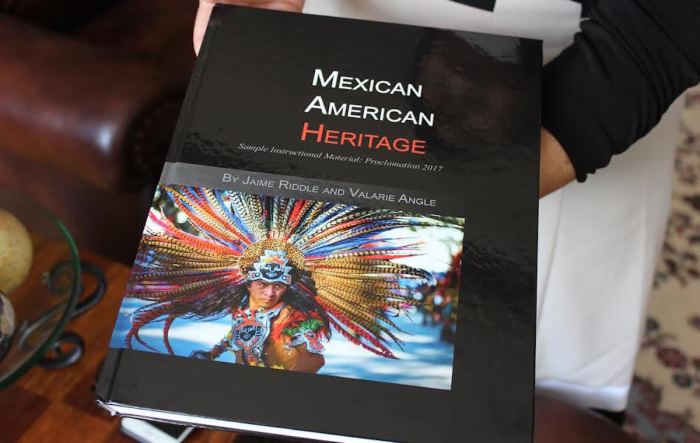
In Texas, where half of all public school students are Latino, the State Board of Education (SBOE) is in the process of approving a new Mexican American studies textbook. The proposal for the textbook was approved two years ago after a petition for a separate curriculum for Mexican American studies was denied in 2010.

“The official curriculum in the state of Texas underrepresents and misrepresents the historical presence of Mexican origin people in this country as well as women and African Americans,” said Emilio Zamora, a professor of Mexican American history at the University of Texas at Austin.

That’s important, because Latino students who learn about their cultural history are more likely to graduate from high school, according to a University of Arizona study in 2015. In the United States, the dropout rate for Latinos is almost three times higher than it is for non-Latino whites.

Only one textbook has since been submitted for review, but it has attracted scrutiny for its contentious handling of Mexican American history. Zamora fears that it will cause more harm than good.

“It was very offensive that they would select people that are not trained or professional historians in the field of Mexican American history,” he said.

The textbook has been submitted by a new company called Momentum Instruction.

Cynthia Dunbar, a member of Momentum Instruction who also served on the SBOE in 2010, says her company hired authors who could review the history fairly.

“They did not want a biased or a skewed viewpoint, they did not want liberally biased, but neither did they want conservatively biased. They wanted people who were willing to just go out and exhaustively review every side of the issue,” she said.

Texans have until November to submit comments about the book, at which point a committee will review them and make recommendations to the SBOE. If recent history is any indication, it’s going to be a big fight.

Unemployed Oil Workers Find New Home in Solar Industry

Eighty thousand workers have been laid off across the country as the price of oil has plummeted. In Texas, some out-of-work rig hands, pipe fitters and engineers are finding employment in solar energy.

David Webster has been managing the Mission Solar warehouse in San Antonio since February. Before finding work in the solar sector, Webster spent 10 years shipping oil out of rigs all over the world. Now, he makes sure that the solar panels are packaged and distributed to customers across the U.S.

Transitioning to solar energy was an adjustment.

“Learning about the different types of [panels], learning how the whole process works, that was a learning curve,” Webster said. “The warehouse portion and the management people, not so much.”

Something else that’s different about his new job — the money. “Over a year’s period of time, it’s about half,” Webster said.

Mariela Cruz, a hiring manager at OCI Power, said that a 50 percent pay cut is pretty typical for people transitioning from oil and gas to solar energy.

“Not to say that we don’t pay well or anything like that, but definitely we know that there is a pay differential for those employees,” Cruz said.

An entry level job in solar pays about $50,000 a year. At the peak of the oil boom, rig hands could be making six figures. But warehouse manager David Webster said it was a hard life. Spending 28 days on the rig and 28 days off took a toll on him. The recent uncertainty in the oil market convinced him to take a pay cut.

“The stress of not knowing if you were going to get laid off, that was worse,” Webster said. “I don’t have any stress here.”

The recent downturn in the oil market has made solar energy jobs more attractive. When Mariela Cruz posts an opening for a solar technician, for example, she gets about 100 candidates, of which 25 percent come from oil and gas. Her challenge is to weed out those who will leave once oil prices go up again.

“You can generally tell that they’re trying to make a different transition, that they maybe are tired of the ups and the downs,” Cruz said. But she says some people are less genuine.  “There are some that will actually candidly tell you, well, I’m only looking for something until the market changes, and you’re like okay, thank you.”

The Solar Foundation says Texas will add 900 solar jobs this year. That’s about one percent of the people who recently got pink slips in oil and gas. John Tintera is with the Texas Alliance of Energy Producers. He says there’s no way this new industry can absorb all of those displaced workers.

“We’re simply not seeing solar having that level of employment,” Tintera said. “If solar continues to grow then I think at least a 20 percent coverage would be something that would not surprise me if I saw that figure in the future.”

But for now, hiring manager Mariela Cruz says getting a job in solar energy is more competitive than ever. She has one bit of advice for oil and gas workers wanting to make the transition: don’t pretend to be a tree hugger and all about renewable energy after a whole career on oilfields.

“After you’ve done [oil and gas] for 20 years it’s kind of hard to say,” Cruz said. “Can I really take that with a grain of salt or not?”

Cruz hopes that the people she hired this year will stay on board, even when oil prices go back up.

Are Gap Years Just For Rich Kids?

408px-Malia_Obama

Check out this story that I reported for Hobsons, a monthly education podcast.

For many students, taking a year off between high school and college to travel the world is considered a rite of passage. In the UK, 5 percent of students deferred college admission for a year. But in the U.S, gap years are still the exception. Just one percent of the more than 2 million high school seniors destined for college, decide to take a break. But this may be changing. Malia Obama’s decision to take a gap year before heading off to Harvard shows that idea finally seems to be catching on stateside. The reason? The benefits it can have on a future college experience.

Latinitas Gets Girls into Tech

Latinitas

Get the full story on NPR’s Latino USA.

Out of all the people earning bachelor’s degrees in STEM subjects (science, technology, engineering and math), just eight percent are Latinos. That number shrinks even more when you look at the number of Latinas (female students).

Alma Benitez was one of those Latinas trying to break into the STEM field, but she faced more obstacles than the prejudice she faced being a Latina: her family hid her college acceptance letters because they didn’t want her to leave home for college. With pressure from inside and outside the home, Alma found support in Latinitas, an after school club for Latinas in Texas that encourages young Latinas to get excited for science, with the hopes that they’ll grow up and pursue a career in STEM.

Reporter Brenda Salinas gives us a glimpse at the particular struggle Latinas face in the world of STEM. She speaks with Alma about her struggle to pursue her dreams, and with Laura Donnelly, the founder of Latinitas, who’s also a Latina computer scientist.


Oil bust forces Texas H-1B visa holders to exit country

Check out the full story on Marketplace.

GettyImages-506079830.jpg

Twenty thousand workers have been laid off this year in the oil and gas industry across the country as the price of oil has slumped. The cutbacks are especially hard for foreign workers here on what are known as H-1B visas. For them, getting laid off doesn’t just mean leaving the office, it means leaving the country.

Scottish-born Graeme Slaven loves living in Katy, Texas.

“We like the fact that it’s easy to make friends here, we like the fact that the education system is fantastic,” Slaven said. “We enjoy being able to live in a house that for the same price back in the U.K. would be about a third or a quarter of the size.”

Slaven had survived several rounds of layoffs at the oil and gas security company where he worked for seven years. When his bosses called him into their office a few weeks ago, he wasn’t surprised. “I wasn’t in shock then, I could read the situation,” he said.

 The same thing had happened to a lot of the friends he met at his local golf club. In just a few months, he saw his entire expat community shrink.

“I actually got to the point where I couldn’t face going to any more going-away parties,” Slaven said. “They were happening with increasing regularity.”

Before getting a pink slip, Slaven was in line to get a green card. He owns a home, his sons play on local soccer teams. His youngest, Niall, who’s 9, has lived here since he was a toddler. “There are only, like, two people that I know in Scotland,” he said.

Slaven and his expat friends used to play golf at the Willow Fork Country Club.

“Every Friday during Lent we had fish and chips, and we had a big crowd that showed up for that,” club manager Richard Rowell said. “You know, if an Englishman tells you the fish and chips are pretty good, you have a thumbs up.”

The exodus of foreign oil workers has hit the club pretty hard in the last few months.

“Eighty to 100 families have relocated to their home country primarily because of job changes and changes in the economy,” Rowell said.

Graeme Slaven has a type of visa called an H-1B. Eighty-five thousand of them are allotted every year to professional workers through quotas to different countries.

Immigration attorney Ken Harder said once a foreign worker is laid off, they have few legal options.

“Much like Capt. Kirk might be beamed up by Scotty, in theory, when an H-1B worker is terminated from employment, he should vaporize and disappear,” Harder said.

Harder’s firm has seen the impact of low oil and gas prices directly.

“I would say since 8 a.m. on January 4th, the first business day this year, we’ve been furiously busy dealing with inquiries both from companies that need to downsize, as well as individuals who have been or are about to be downsized, so it’s been a real profound issue given the local economy here in Houston these last few months,” Harder said.

Slaven has a slim margin of hope. If he can find another employer willing to sponsor him, he can stay — but he knows that’s unlikely.

“The best-case scenario is a miracle,” Slaven said, “that somebody else is interested in employing me. The chances of that at this point in time are slim.”

A quick search on a job board turns up just a few companies willing to sponsor H-1B visas. Most of those companies are in IT, which is not a field Slaven has experience in.

Right now he’s trying to figure out a way to stay in the U.S. until the end of the school year, before he moves his family back to Scotland — a move he’s trying desperately to avoid.

For Entrepreneurs, Pitching To Pint-Sized Sharks Is No Child’s Play

Check out the full story on NPR.img_0427edit_custom-c7ecf8aeb9159a2338e4bf4ad625483219f1971d-s800-c85


A few weekends ago, Texas entrepreneur Regina Vatterott stood in front of 50 people on the top floor of a startup hub in Austin. She was there to pitch her smart pill box company, EllieGrid, to a panel of six judges.

“If you or your dad or mom has to take medications at breakfast, at breakfast time, the three compartments light up, and you would take, let’s say, two from this compartment, three from this compartment and one from this compartment, and it also sends you notifications on your smartphone so you can track it all online, too,” Vatterott told the judges.

It was like Shark Tank — the reality television show where entrepreneurs take turns pitching their companies to a panel of investors — but with a twist.

This panel of “sharks” is made up of kids.

Welcome to Pitch-a-Kid, where kids and entrepreneurs can learn from each other.

Regina Votterott won over the Pitch-a-Kid judges with her idea for a smart pill box.


Unlike the entrepreneurs on Shark Tank, Vatterott’s goal isn’t to get investors — there’s no cash prize at Pitch-a-Kid.

Still, it’s hard fought: Each entrepreneur at the first Pitch-a-Kid event has 5 minutes to present and up to 8 minutes of questions from the judges. And the kids are asking some tough questions: How do you make money? How are people going to pay for it? Do you provide a warranty if it breaks?

The judges hear six more pitches, including a social media network for books and a subscription “sock of the month” company idea.

Anicia Moncivais, the judge coordinator, is a 12th-grader; the five other kids are third- through sixth-graders. They turn in their score sheets and then deliberate.

“The judges have spoken,” intones Piers Powell, one of the judges.

Mike Millard, a co-founder of Pitch-a-Kid, announces the winner: Regina Vatterott’s company EllieGrid, the smart pill box maker.

Vatterott says she was a little nervous before her pitch.

I didn’t know if they understood the grand scheme of how important medication adherence was, but they really seemed to get it, they didn’t even ask questions about that,” she says.

Audrey Millard, daughter of Mike Millard, Pitch-a-Kid judge and co-founder, says she definitely held back.

“My dad was telling me in the car, like, how nervous these people were, and how they’re, like, I don’t know how to explain this in a kid-friendly language, oh no what will I do if they don’t understand me, and stuff like that, so I decided not to go too hard on them,” the 9-year-old says.

“About a year ago, I was doing a website with my daughter, and she asked me really tough questions,” Millard recalls. “She said, who’s the website for, how are they going to know about it, and what I realized was that they were nonfiltered, honest questions on how to be successful.”

In other words: If you can’t explain it to a kid, you probably aren’t ready to talk to investors. And just because the judges are small doesn’t mean they don’t take their job seriously — including what they were going to wear.

Before the event, Audrey says, she researched how to look “businesslike.”

The kids in the panel and in the audience got an introduction to the startup culture, and the entrepreneurs practiced addressing some of the issues they need to think through for their business model to succeed.

The next Pitch-a-Kid event in Austin is scheduled for July 30.

Why This Small Coffee Business Doesn’t Need to Compete on Price

tgim_blog_ep6-4

Every coffee company has an angle.

Folgers made it fast. Nabob made it romantic. Starbucks made it hip. And today, artisanal coffee is making it expensive. But how do you convince someone to pay a lot more for their coffee? The answer is actually pretty simple: all you need to do is tell a story.

We sat down with Helen Schafer, owner of Tiny House Coffee Roasters, to find out more.

In this interview, you’ll…

  • Find out how a great story can help you charge more for your products
  • Discover an easy way to tell your story (without an advertising budget)
  • Learn about product positioning and why it’s your key to boosting sales

Check out the full interview below:

Want to hear more? Listen to the rest of episode six now.

Stem Cell Therapy For Pets

Get the full story on PRX

Scientists discovered how to extract stem cells from human embryos in the early 2000s. Stem cell research got many people excited but there was a lot of controversy and suspicion surrounding this breakthrough. We haven’t heard much about stem cell research since then, but there are some medical professionals are using the technology: veterinarians.

More than 12,000 animals have been treated with stem cell therapy in the U.S. since 2004. The trend started with racehorses but is now available to domestic animals.

The industry is worth $20 million a year – that’s small compared to the $2 billion dollars Americans spent on pharmaceutical drugs for their pets in 2014. But the industry is expanding fast. There are three companies offering stem cell therapy for pets. A new facility opened in New York in August.

Tony Yuan owns a company called Mobile Stem Care in San Antonio. He says business is good because a lot of people are willing to spend serious money on their pets.

Roger Burton is one of his customers. A long-time hunter, Burton noticed that his Lewellin Setter, Reece, was limping out on the fields. He had never really thought about stem cell therapy for animals, but his doctor convinced him that the risks were minimal.

Burton was impressed with the results of the treatment. “Since the next day I have not seen her struggle at all, this is one happy dog,” Burton says. “She was on two forms of pain reliever, we just took her off of it and all I saw was progress.”

Burton paid upwards of a thousand dollars for the treatment. “I haven’t run across a situation yet where I haven’t done a procedure because of cost,” Burton says. HIs veterinarian, doctor Rachel Smith says she’s never seen patients so willing to spend money on their pets – just think of memory foam dog bed and pet health insurance.

Tony Yuan says that sentiment translates into medical procedures, so the margins for animal stem cell therapy are good. He says it would take him about $20 to bring stem cell therapy to humans.

Doug Frantz teaches bio-medical engineering at the University of Texas San Antonio. He says it will probably be another 10 years before humans can be treated with this type of therapy – and that’s a good thing.

“There’s a lot of regulations when you’re making that jump from veterinary medicine to medicine for humans,” Frantz says, “You really don’t have to have that regulation for animals because the FDA is not really interested in regulating those to that level.”

For the FDA to approve a drug or medical procedure for humans, it has to be better than the existing gold standard. For animals, the procedure has to just be proven safe. Scientists around the world are running hundreds of clinical trials proving the effectiveness of stem cell therapy in humans – and that is going to take a while.

That doesn’t stop people like Roger Burton from daydreaming about getting the same procedure as his dog. “I have a torn meniscus in one of my knees and I would love to have it done today,” Burton says.

But that’s not going to happen anytime soon without FDA approval.