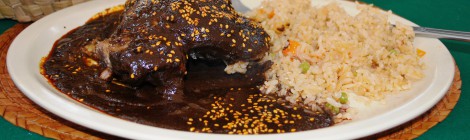
Latinos have a way of making American traditions all their own. We asked our listeners on Twitter and Facebook, “How does your family add some Latino flair to Thanksgiving?” I joined Latino USA host Maria Hinojosa in the studio to share our their responses.
Photo courtesy of Alejandro Linares Garcia, Wikimedia Commons
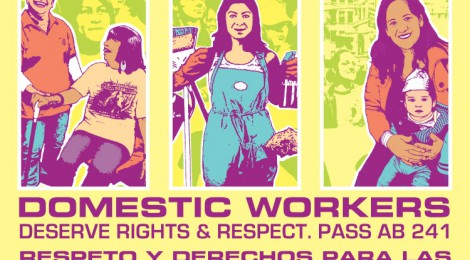
This year, California passed a Bill of Rights protecting domestic workers. New York and Hawaii have passed similar bills. But what is going on in the other 47 states? Andrea Cristina Mercado is the campaign director for the National Domestic Worker Alliance. She joins host Maria Hinojosa to talk about how the legacy of slavery makes it difficult for domestic workers to organize and how despite obstacles, the domestic worker movement has grown.
Photo courtesy of Dignidad Rebelde.
Photo courtesy of National Domestic Workers Association.
Andrea Cristina Mercado is the daughter of South American immigrants, the mother of two small girls, and the new Campaign Director at the National Domestic Worker Alliance. For the past eight years Andrea has been organizing at Mujeres Unidas y Activas (MUA), a grassroots Latina immigrant women’s organization in the San Francisco Bay Area. She is one of the co-founders of the National Domestic Workers Alliance and has played a leadership role in building and coordinating the California Domestic Worker Coalition, a statewide effort to include domestic workers in labor laws.
Even though you might be living behind bars, the desire to create still lives inside you. You’ll grab whatever materials you can find and make something to pass the time, to express your fears and to make a statement about your life. In the 1990s, Chicano prisoners in San Antonio, Texas, took square pieces of cotton, called Paños, and created elaborate scenes with ballpoint pen. Some curators now recognize them as folk artist.
Maria Hinojosa went to the home of David Joralemon, a New York art collector and spoke to curator Martha Henry. Part of David’s collection is currently on tour in Venice.
There’s been a lot written in the past year about women balancing work and family, but what that means for Latinas can be complicated — especially in the world of business. Do they tone down their cultural differences to be accepted in the workplace? Maria Hinojosa talks to the president of Barnard College, Debora Spar. In addition to leading the women’s Liberal Arts college, Spar wrote the book Wonder Women: Sex, Power and the Quest for Perfection.
Debora Spar is president of Barnard College and the author of numerous books, including, most recently, Wonder Women: Sex, Power, and the Quest for Perfection. Prior to her arrival at Barnard in 2008, Spar was the Spangler Family Professor at Harvard Business School, where her research and teaching focused on political economy and the various ways in which firms and governments together shape the rules of the global economy. Spar also serves as a Director of Goldman Sachs and trustee of the Nightingale-Bamford School.
Goth culture. Is it in? Is it out? Do they even care? Hear the stories of three Latinos who found a sense of community in Goth subculture while we try to answer the question of the ages: Why are Latinos obsessed with Morrissey? It’s not just the Pompadour.
Photo credit Suzy Exposito.
Nadia Reiman has been a radio producer since 2005. Before joining the Latino USA team, Nadia produced for StoryCorps for almost five years. Her work there on 9/11 stories earned her a Peabody Award. She has also mixed audio for animations, assisted on podcasts for magazines, and program managed translations for Canon Latin America. Nadia has also produced for None on Record editing and mixing stories of queer Africans, and worked on a Spanish language radio show called Epicentro based out of Washington DC. She graduated from Kenyon College with a double major in International Studies and Spanish Literature Continue reading “Goths: Latinos On The Dark Side”→
Captain Bryon J. Owen has led three recovery missions to Papua New Guinea and recovered the remains of nine American personnel. His personal decorations include the Silver Star, Bronze Star with combat V, the Purple Heart, the Meritorious Service Medal, the Joint Commendation Medal, the Navy Commendation Medal, the Navy Achievement Medal with gold star and combat V, and the Combat Action Ribbon w/gold star. He was the 2012 recipient of the Navy League’s General John H. Lejeune Award for Inspirational Leadership.
It’s not just Latinos who are hoping the government shutdown ends and Congress can get back to work on immigration reform. The business community, and in particular the tech sector, wants to see legislation too. Brad Smith, Microsoft’s general counsel and executive vice president, talks with Maria Hinojosa about why he cares about immigration reform. He discusses how essential immigrant workers are for the tech sector, and the American economy as a whole.
When you think of Mexican food, the first thing that comes to mind might be burritos or nachos, but that’s not really Mexican.
At least that’s what the Mexican Gastronomic Conservatory told UNESCO, the United Nations Educational, Scientific and Cultural Organization.
Margarita de Orellana is with the group of Mexican Academics who put together the first cookbook to be included on Unesco’s Intangible Cultural Heritage list.
“We said ‘No, that’s not Mexican, that comes from the south of the United States. It’s great, but it has nothing to do with the ways and traditions of our cooking,'” says Orellana.
The conservatory organized experts and artists to create an authoritative guide to Mexican food. It focuses on the food of the Michoacan region, which Unesco specifically highlighted as being culturally significant.
The metate is a type of stone mortar and pestle used for grinding up spices in Mexican cuisine.
The book examines traditional kitchen utensils like the Metate — a type of stone mortar and pestle, and indigenous ingredients like cacao (cocoa), avocado, corn and an aztec delicacy called huitlacoche.
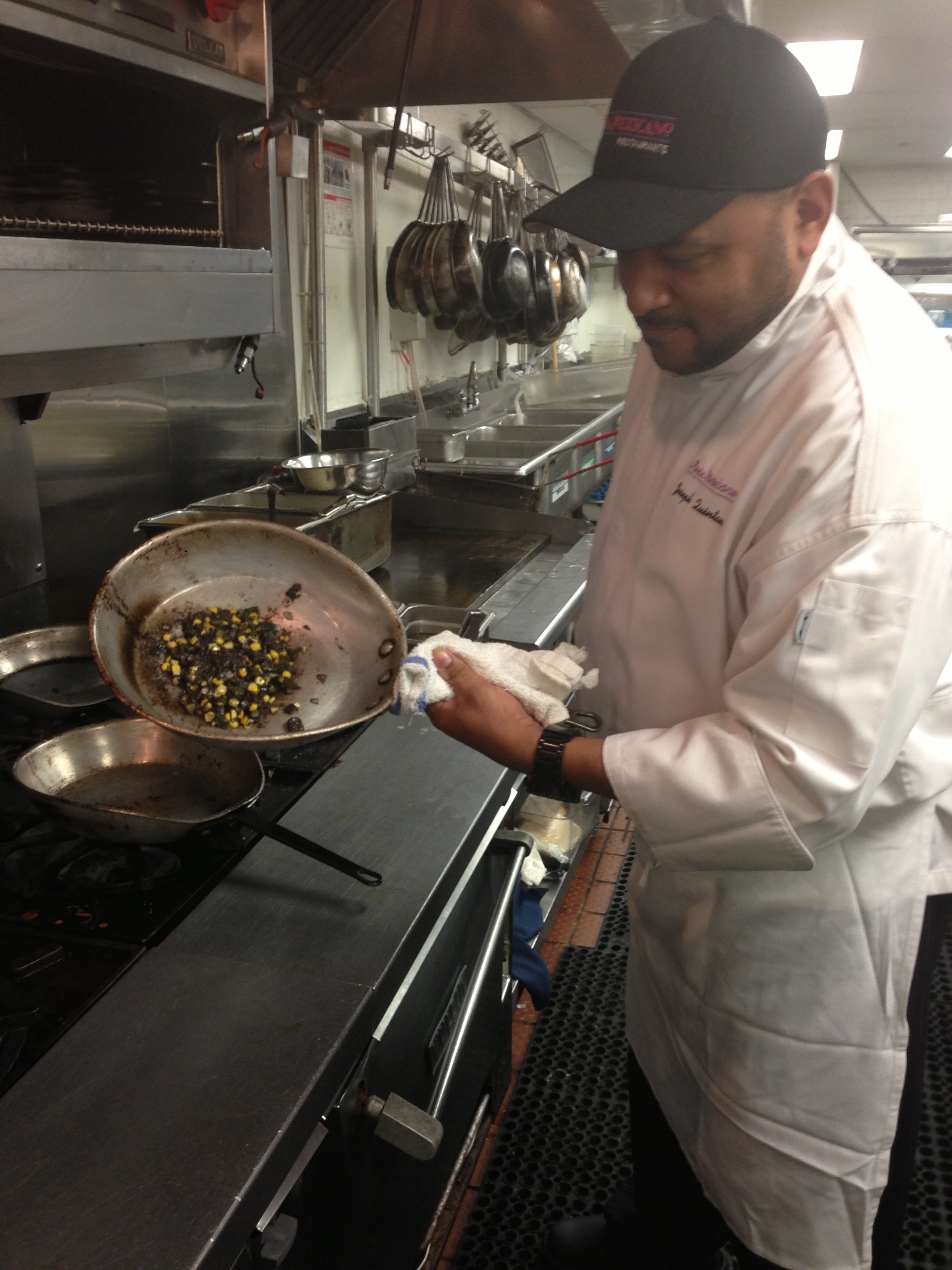
Joe Quintana is the head chef of Rosa Mexicano, a downtown New York City restaurant specializing in Mexican cuisine. He loves cooking with huitlacoche, which he calls “the caviar of corn.”
Margarita de Orellana understands why. “That’s one of the most exquisite dishes that we have, because you know huitlacoche is a mushroom that is like a sickness of the corn that grows all over the world, but nobody really knew what a specialty and how wonderful this part of the corn is. ”
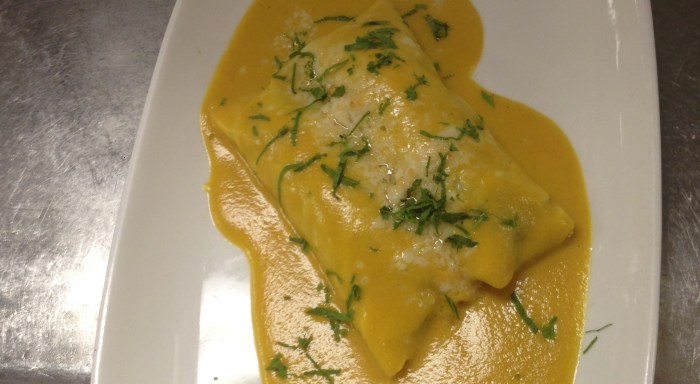
His favorite dish to make is huitlacoche crêpes, which he says demonstrates the influence French cuisine had on traditional Mexican ingredients.
Chef Quintana’s huitlacoche crêpes recipe:
Ingredients:
For the crepes:
4 eggs
1 1/3 cups milk
2 tablespoons melted butter
1 cup flour
½ teaspoon salt
For the filling:
1 pound fresh huitlacoche or oyster mushrooms
2 ½ tablespoons corn oil
½ medium white onion, peeled and chopped
2 large cloves garlic, peeled and chopped
1-2 serrano chiles, seeded and finely chopped
1 sprig epazote (leaves only) chopped
salt to taste
For the sauce:
4 poblano chiles, seeded (not necessary to peel them for this recipe)
1 cup milk
2 tablespoons butter
2 tablespoons flour
1 cup Mexican crema or heavy cream
salt to taste
grated mild melting cheese (Mexican manchego, jack, gruyere or fontina) for topping
Preparation:
Make the crepe batter: Place all ingredients in a blender and liquefy until smooth. Let batter rest at least 30 minutes while the filling and sauce are being made.
Make the filling: Coarsely chop the huitlacoche or setas and set aside. Heat the oil in a skillet, add the onions and sauté until they begin to soften. Add the garlic and chile and continue to cook for 5 minutes. Add the huitlacoche or setas and cook until they have rendered their juice and it has nearly evaporated. Stir in the epazote.
Make the sauce: Roughly chop the poblanos, place them in a blender with the milk, and liquefy to make a puree. In a saucepan, melt the butter and whisk in the flour to make a light roux. Add the chile puree and stir with a whisk until it has thickened to the consistency of heavy cream. Remove from heat, add the crema and salt to taste.
Make the crepes: Heat a bit of oil in an 8″ crepe pan, wiping with a paper towel to coat the surface. Pour ¼ cup crepe batter into the pan and roll the pan around to coat the bottom with batter. When the edges of the crepe start to dry and turn up, turn the crepe over and continue to cook for 1 minute.
Place the crepe on a plate and repeat with remaining batter, stacking the crepes as they are finished.
Assemble: Divide the filling evenly among the crepes, roll them up and place them in a lightly greased oblong baking dish. Pour the sauce over the crepes and bake them at 350º F for 25 minutes. Sprinkle with the cheese and bake another 5 minutes, or until cheese has melted. Serve immediately.
Being bicultural, multicultural, ambicultural…it can get complicated. We want to help out. We’ve teamed up with Latina’s Magazine’s advice columnist Pauline Campos for a new recurring segment we like to call #LatinoProblems. Our social media diva Brenda Salinas attended a conference in New York for Latinos in social media in called Latism, and they found plenty of people with plenty of questions.
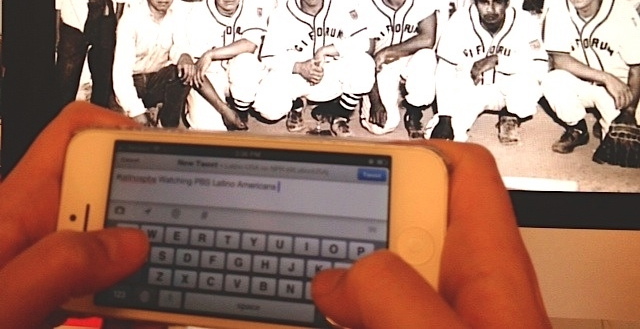
Latino USA social media producer Brenda Salinas steps away from Twitter and into the recording booth to talk to host Maria Hinojosa. They discuss how social media has reacted to the PBS series “Latino Americans.”


 Debora Spar is president of Barnard College and the author of numerous books, including, most recently, Wonder Women: Sex, Power, and the Quest for Perfection. Prior to her arrival at Barnard in 2008, Spar was the Spangler Family Professor at Harvard Business School, where her research and teaching focused on political economy and the various ways in which firms and governments together shape the rules of the global economy. Spar also serves as a Director of Goldman Sachs and trustee of the Nightingale-Bamford School.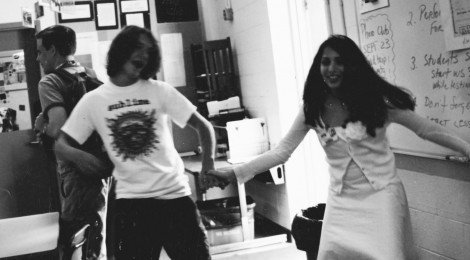
 Nadia Reiman has been a radio producer since 2005. Before joining the Latino USA team, Nadia produced for StoryCorps for almost five years. Her work there on 9/11 stories earned her a Peabody Award. She has also mixed audio for animations, assisted on podcasts for magazines, and program managed translations for Canon Latin America. Nadia has also produced for None on Record editing and mixing stories of queer Africans, and worked on a Spanish language radio show called Epicentro based out of Washington DC. She graduated from Kenyon College with a double major in International Studies and Spanish Literature




 brendapsalinas.com