Hearing Aids: A Luxury Good For Many Seniors

Get the full story at NPR

istock_000019931082large-1--712af12288509b40a221a5e21aa2d95ef945a9ed-s3-c85

More than 30 million Americans experience significant hearing loss, but only a third of them get hearing aids.

There are a lot of reasons why someone who needs a hearing aid won’t get one: Some think their hearing loss is not that bad, others are too embarrassed to use them, and many people say they are just not worth the price.

Hearing aids cost an average of $1,500 per ear for a basic model, and unlike most technology, their price has not dropped over time.

What is worse: Most insurance companies do not pay for the devices. Even Medicare does not cover hearing aids — and the Affordable Care Act will not change that.

Some businesses see the hearing aid market as an opportunity. Costco has opened hearing aid centers in discount warehouses all over the country. Other companies have started selling their own brands of the devices directly online.

Ross Porter, the founder of online retailer Embrace Hearing, says hearing aids are only expensive because audiologists and distributors charge steep markups on them.

But Virginia Ramachandran, an audiologist with the Henry Ford Hospital in Detroit, says it is unwise to buy a hearing aid for the first time online. She says the device might be fine, but you will not know how to use it correctly.

“If someone gave you a laptop computer, and you have never used one before, you would not know how to turn it on, you would not know what programs or how to use them,” she says.

Ramachandran says the only way to make hearing aids cheaper is to have more consumers enter the market. That way, she says, some of the research and development costs incurred by the industry leaders could be divided among a larger group. (According to the National Institutes of Health, “Only 1 out of 5 people who could benefit from a hearing aid actually wears one.”)

Besides, Ramachandran says, what really keeps people from purchasing hearing aids isn’t the cost — it’s the stigma.

She led a study in 2011 where she divided patients into three groups. The first group could receive their hearing aids for free through their insurance, the second group was partially covered, and the third group had to pay for them out of pocket. Researchers then noted how long it took a patient to get a hearing aid.

They found little difference between the groups with partial or no coverage — but there was a “significant decrease in both the age and degree of hearing loss” for those whose hearing aids were fully covered by insurance.

Dropping the cost of hearing aids can nudge a senior in the right direction, but there are always going to be people who would rather go without.

Ramachandran says that in European countries where hearing aids are covered by insurance, rates of adoption are not significantly higher than in the U.S. She says cost might be a way to stall.

“People genuinely perceive hearing loss as being associated with older age, so any excuse not to get them is a good one if it is something that you do not really want,” she says.

If seniors saw the devices as something as normal as eyeglasses, she says, they would be more likely to get them. This would expand the market and could eventually bring the price down.

The industry is already on it: Companies are in the market for aging celebrity spokesmodelsto make the pitch.

Local Artists Struggle To Find Affordable Health Care

Get the full story at KUHF

artist-health-insurance2-brenda-salinas-640px-1

William Miller is using his studio in the Heights for some decidedly uncreative things. His health insurance runs out next month, and he has to figure out a way to make things work. He’s HIV positive and borderline diabetic, which puts him in a high risk pool. This is the first time he’s without a safety net.

He got laid off from his job as a graphic designer last year and now he pursues his art full time. He estimates he’d have to sell 9 paintings a month to pay for the level of care he has now.

“It’s expensive, there’s no other word for it, it’s expensive. You know, they used to say well make sure that your rent and other expenses are like 25 percent of what you’re bringing in. Well, you add healthcare to that and it’s double, triple that.”

He’s thinking about getting a part-time job at Starbucks just for the benefits. But that would take him away from his studio, so he’s looking for other options. He found Legacy, a community clinic in Montrose that’s willing to treat him.

They’re helping him apply for federal coverage under a grant for HIV positive patients. If that doesn’t work out, they have a sliding scale fee structure for their uninsured clients.

Kimberley Paulus is with Legacy. She says their Montrose clinic serves many people in Houston’s entertainment industry.

“The artist community is such an important part of Montrose and our culture here in Houston and an interesting component of that is oftentimes those people face difficult access to care. Many of our fine artists and musicians go insured or underinsured.”

Legacy has been operating in Houston for 30 years, it played a key local role in the 80’s AIDS crisis. Now they’re a federally qualified health center. They provide preventative care, dental, pediatric — the works.

They say they’re trying to combat the sick, starving artist stereotype. Legacy says the situation has gotten a bit better since The Affordable Care Act started kicking in. Young people can stay on their parent’s insurance until they’re 26 and it’s easier to get coverage from a spouse. But for artists like Miller who don’t fall under those categories, it’s tough.

“Medicine costs so much, appointments cost so much, blood work costs so much, so do you decide to spend the money on that or the rent for your studio? Do you spend it on materials so you can sell more art — there always seems to be that trade-off.”

Freelancers in other cities have organized to buy health insurance as a group, but that’s yet to happen in Houston. For the meantime, the people behind Houston’s vibrant arts community are finding their own ways to get healthcare, even if that means staying uninsured.

Rice Students Make A Better Cup Of Space Coffee

Get the full story at KUHF

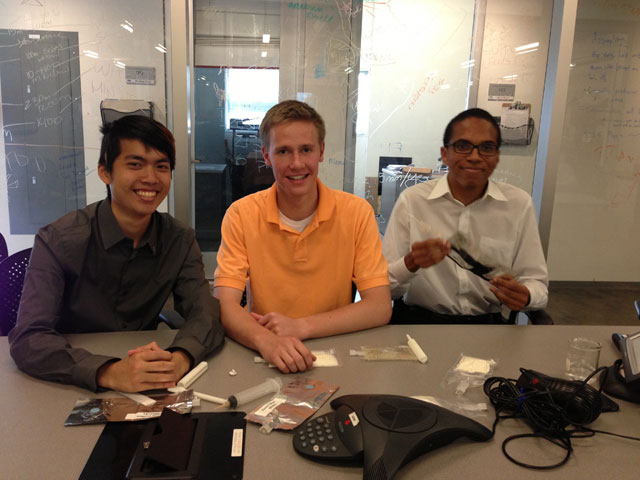
Benjamin-Young-Colin-Shaw-and-Robert-Johnson640px

When Astronauts drink coffee in space, it’s hardly a gourmet experience. Like all liquids aboard the International Space Station, coffee comes freeze dried in an aluminum pouch. Astronauts rehydrate the pouch with hot water from a dispenser and drink through a leak-proof straw. The problem is that they can’t add anything to it because it might leak and damage the equipment. For now, there are just four ways astronauts can have their premixed coffee: black, with lots of sugar, lots of cream, or lots of both.

That’s how the Texas Space Grant Consortium described the problem to Rice students Robert Johnson, Benjamin Young and Colin Shaw in their Intro to Engineering class.

From the start, they started imagining what it would feel like for their design to go into space. This is Shaw:

“I think in first grade when I assembled all of the Jupiter and all of its moons. I thought being an Astronaut would be pretty cool. Since then I have toned down my dreams a little bit to just send stuff to the ISS.”

Throughout the year, Shaw’s team developed a system using aluminum pouches and a 3D printed roller to help Astronauts customize their coffee.

They had to develop a way to pour exact amounts of cream and sugar into coffee without the use of gravity. They started by putting creamer and sugar into aluminum pouches. They adapted NASA’s leak-proof straws to link the pouches together. Then they designed a special roller to push the condiments out of the bag. It looks like those plastic gadgets used to squeeze the last drops of toothpaste out of a tube.  The execution? It’s pretty easy.

First you add hot water to the coffee pouch. And then…

“I connect the pouch to pouch adapter from the coffee pouch to the sugar pouch. I unclip the clamp and start proportioning my sugar.”

A few cranks of the roller and the sugar is pushed into the coffee through the special straw. The lines on the pouch tell you exactly how much is going in. Same with the non-dairy creamer.

“I mix it around a little bit, unclip the clamp, and drink.”

Compared to the condiment bar at Starbucks, it might seem complicated, but the students say it’s a small sacrifice for the ability to make a perfectly blended drink. They hope that with more testing their invention will be ready to go up to the International Space Station.

NASA has told them that it might have other uses, like any time a precise amount of liquid has to be dispensed without the help of gravity, for example with IVs.

Friends Of The American Latino Museum Hold First Town Hall In Houston

Get the full story at KUHF

Latino-museum-pics640px


There are currently 12 museums on the National Mall and one more under construction. The National Museum of African American History and Culture is scheduled to open in 2015. A group of activists is now urging the Smithsonian to build another ethnic museum, this one to celebrate Latino contributions to the U.S.

The idea for a National Latino museum was borne in 1990 when a task force reported the Smithsonian was largely ignoring Latinos in its exhibits. At the time, out of the 470 “notable Americans” in the National Portrait Gallery, only 2 were Latino.

Since then, the Smithsonian designated an internal office devoted to including Latino stories within the existing framework.

But The Friends of The American Latino Museum say that’s not enough. Estuardo Rodriguez represents the group.

“The truth is there’s so much more out there that simply isn’t being told and instead of pointing fingers, we simply suggest that it’s time for a national museum on the National Mall to fill those gaps.”

Congress is currently reviewing a bill to designate a vacant Smithsonian building as the future home of the American Latino Museum.

Critics of the project say the Smithsonian should stop building specialty museums and should instead concentrate on improving the ones it already has. New museums are expensive, and some argue that ethnic museums promote cultural isolationism.

Maggie Rivas-Rodriguez is a journalism professor at the University of Texas Austin. She says the American Latino Museum isn’t about segregation, it’s about education.

“As long as there’s that lack of awareness, people aren’t going to understand that we’re not all immigrants. We’ve made a lot of contributions to our country, our communities, to our states. And there’s still this sense among people that we’re outsiders; we’re not outsiders.”

Rivas-Rodriguez hopes the museum’s creation will prompt the inclusion Latino-American History in schools all over the country, which she says is sorely lacking. She wants the museum to be a national meeting place, and a symbol of the experiences of the more than 50 million Latinos living in the U.S.

Why Texas Summer Camps Attract Kids Across The Country

Get the full story at KUHF

Camp-ASCCA-photo-flickr-350px

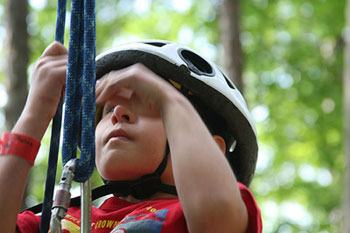
There are more than 560 summer camps currently operating in the state of Texas. And in just two weeks’ time, they’ll be welcoming kids to their campsites once more. Mike Mcdonell is with Kidventure, the largest day camp program in Houston.

“There is a great sense of anticipation. It’s almost like a team in the locker room waiting to come out for the first quarter, you know. And you can hear the crowd, and you know the kids are there, and it’s a blast.”

For McDonnell, it’s crunch time. He has just a couple of days to make sure every detail is in order. So far, he’s hired 260 counselors and directors to operate his 12 campsites. Right now they’re in training, learning first aid and camp protocol before the official start of summer.

Summer camps are a competitive market across the country, they’re estimated to be an $11 billion industry. Most camps in Texas are non-for-profit day time facilities. There’s a program for almost any interest or activity: Zoology, Computer Science, Rock and Roll, Cooking, and of course the more traditional experience.

Tim Huchton leads the Texas branch of the American Camp Association. He says compared to the rest of the country, Texas has a natural edge in attracting campers.

“There are parents who fly in their children from all over the world to come to summer camp in the state of Texas.  The weather in Texas is nice and warm, there’s plenty of water where they can go swimming. It’s just a fantastic area.”

But as attractive as it is, Huchton says Texas summer camps have had to keep up with technology to attract campers.

“With the change in technology, everyone is having to learn new ways to market themselves and to stay in the cutting edge and so for an industry that doesn’t necessarily do a lot of technology, summer camps have come a long way in terms of using technology to market themselves.”

Huchton says most camps are active on social media. They use Facebook and blogs to sell their unique summer experiences to parents and then to keep them updated while camp is in session. But Hutchon says there’s no better marketing than word of mouth. If you want to stay in the black, you have to keep families coming back year after year.

Furry Friends Help Rice Students De-Stress During Finals

Get the full story at KUHF


This slideshow requires JavaScript.

Something unusual is happening at Rice University. Students in the library are closing their laptops, putting away their textbooks and dropping to the floor.

“Scarlett! Come see all these people that want to see you!”

A dozen dogs of all shapes and sizes, plus a few cats, are enjoying belly rubs in the middle of a reference room.

“Bring up sound of shaking dog.”

Rice is among a growing number of colleges bringing therapy dogs to students during finals week. The idea is that playing with a pet can decrease feelings of anxiety.

Agnes Ho is a Counselor at Rice.  She says it might seem silly, but bringing pets into the library really works.

“This is really helpful, as you can tell the students feel really excited when they see dogs coming in and they can take a break and they can step out of that very stressful moment like take a deep breath.”

She says Rice organizes this and other events like catered study breaks and midnight breakfasts to remind students that they’re not alone. 

On the floor between two shelves, Senior Sam Newman is snuggling a Great Dane and a Chihuahua at the same time. He acknowledges that stress can be a real problem.

“Freshman fall was probably my hardest semester, actually, I was taking multivariable calculus and I hadn’t taken math n a few years, and it was kind of like a punch in the gut, but since then it’s been more smooth sailing, I guess.”

Since then he’s picked up some tricks to manage his time better. He has some advice for underclassmen.

“Keep your wits about you. Make a list of all the things you have to do and try to get things done one at a time.”

Rice first invited therapy dogs to campus last December, and they were such a huge hit with students that they decided to do it again.

Alley Theater Announces $73 Million Renovation To ‘Ensure The Theatre’s Future’

alley-theatre-rendering-350px
Get the full story at KUHF

The Alley Theater in downtown Houston is one of the city’s most significant landmarks, its opening in 1968 was a nationally chronicled event. Forthcoming renovations will only bring a deep cleaning to the building’s façade. The inside, however, will be almost unrecognizable.

The plans include a reconstructed lobby and a complete renovation of the theatre’s largest stage.

Gregory Boyd is the Alley Theater’s artistic director. He says the stage was constructed at a time when minimalist productions were in fashion, and that this has limited their more modern stagings.

“The building hasn’t been renovated since 1968, so theater technology has taken leaps and bounds in that time, obviously, so we want to make the alley more friendly to modern means of production, but we also want to make more intimate the relationship between the actor and the audience.”

The remodeling will come at the end of a $73 million dollar capital campaign, of which $31 million has already been pledged. The reconstruction will also bring more educational and event spacing and significant green energy upgrades.

Houston Students Celebrate Latino Culture Through Mariachi Music

Get the full story at KUHF

This slideshow requires JavaScript.


It’s an ordinary morning at Patrick Henry Middle School in Northeast Houston. 

Jose: “Good morning. Start up. Warm up.”

Thirty students are scrambling into a music room, greeting their teacher, picking up their instruments and practicing their music.

But not just any music …

[music: “LOS PATRIOTAS DE HOUSTON TEJAS”]

Mariachi is a type of Mexican folk music. It’s played at celebrations like weddings and quinceañeras. Musicians wear elaborate suits called traje de charro.

They play violins, trumpets and different sized guitars. The music is about love, pain and betrayal.

[music: “LOS PATRIOTAS DE HOUSTON TEJAS”]

That’s Giana Mijares, the group’s lead vocalist.

She’s 12 years old. She enrolled in this school specifically for the Mariachi program.

“It taught me so well by learning different instruments, its history, and how our culture, or Mexican culture really represents that music. And it’s very good to actually be a part of it and just be proud of it and representing the Mariachi music too.”

Giana credits her dad for her love of Mariachi music. When he heard her singing ballads by the Tejana idol Selena, he put her in vocal lessons with Jose Longoria, the director of the Mariachi program at Patrick Henry.

Longoria recruited her for his program and now she’s one of his 60 students.

The program started almost by accident. 12 years ago, Longoria was working as a math teacher, performing music with his brothers on the side. They were entertaining the crowd at a school luncheon when the school’s superintendent approached him. He said, “Let’s start a Mariachi program.”

Longoria was in. But he knew if the program was going to work, it’d have to be serious. Now his students are more than a band, they’re a team. And he’s as strict as any coach: the kids have to pass all their classes to perform. 

“The responsibility to make sure that they come, that they participate in fund raisers, all that goes back to them. So those are skill building that they’re going to need in the real world for when they have a job. They have to be participating; they have to do their best.”

Some of the kids want careers in music. Others are happy just to learn. Either way, Longoria says the best part of the program is that it helps them be proud of their culture, their families. And based on how many people show up to their performances, he says their families are proud of them too.

US Rep. Sheila Jackson Lee Sits With Students To Discuss Gun Violence

Get the full KUHF story.

Elementary school students in the 3rd Ward crowded into a gymnasium to participate in a lecture by a guest speaker.

“Is this the type of gun that you should have?”

” NO!”

” Should you be on the street with this type of gun?”

” NO!”

That’s Congresswoman Sheila Jackson Lee. She says she’ll use her influence in the house to push against the threatened filibuster in the Senate.

She wants schools to be secured by armed guards, not by teachers with guns.

“I think there are Houstonians who believe in this and I think there are Americans who believe in this, and Congress must be guided by America’s wishes and desires, we are the representatives of the people.”

Sean Holcomb is a teacher at Koinonia Community Learning Academy. He says talking about guns in school is important. His young students are already familiar with gun violence.

“Their families usually carry guns or they wake up to sometimes to policemen sometimes raiding their houses looking for those types of weapons, so they’re actually very knowledgeable about guns. They know about them. They know what to do with them and they know what they can and cannot do.”

Holcomb says that youth violence in an epidemic larger than laws, but still commends legislators’ efforts to do something about it. The Senate will cast its first vote on President Obama’s gun-control proposals on Thursday.

Does A Hospital Really Need A Facebbok Page?

Photo Illustration by Gerald Rich, KUHF

Get the full KUHF story

A hospital isn’t a place any of us want to be. So who would “like” one on Facebook? 70,000 Houstonians do . St.Lukes, Texas Woman’s, MD Anderson — they’re all active on the site.

For the people behind these pages, it’s a full time job. Like Jason Lauritzen, he’s a social media specialist with The Methodist Hospital System.

He says it’s a full time job, “We do have a calendar of maybe content we want to share with people. We curate some information about health news and someone says, ‘Hey can you provide more information on that,’ or ,’Can you put me in touch with a doctor?’ We go out, and we do those things for them.”

Lauritzen says social media is part of a hospital’s brand. He wasn’t surprised when he heard a new study linked Facebook likes to quality.

The study found that out of 40 New York Hospitals, the ones with more Facebook likes also outscored their peers in traditional measures of care, like 30 day mortality rates and patient recommendations.

Paloma Luisi is one of the Healthcare Institute and Technology Lab researchers who conducted the study. She says the Facebook like is a power metric, “We can look at and see does this have any valid findings in measuring patient satisfaction and hospital quality. And we think that it might, but it deserves future research.”

But hospitals scrambling to put up a Facebook page should be careful. Dan Hinmon works with hospitals on their social media presence, he says the worst thing a CEO could do after reading this study is to tell a marketing director to go throw up a Facebook page. “Facebook can be powerful in terms of building good relationships with patients. But if you don’t do it right, the very opposite can happen. Patients can decide that you don’t really care and aren’t interested in them. And that can reflect on the entire quality of your hospital”

Hinmon says people who like a hospital on Facebook personally connect with one of its services. Cancer and maternity centers tend to get more traffic.

It’s still not clear what Facebook means for quality of care across the country, but hospitals are connecting with patients in a new way, long after they’re discharged.