Houston Is A Leader In The Funeral Industry

Funeral Museum 1Get the full story on the Texas Standard

If you’ve ever worked in the funeral industry, you know exactly who Bob Waltrip is. Waltrip is the John Rockefeller of funerals. He’s the godfather of the funeral industry.

Drive north of downtown Houston and you’ll find the National Museum of Funeral History. The museum’s main benefactor is Service Corporation International, the largest funeral home conglomerate in the world.

Museum director Genevive Keeney says the site is home to the burial plots of some of the world’s most influential entertainment figures.

“So I have just a little of everything in here, I mean there’s just like I say a century overload we pay tribute to cowboys, cowgirls that were in the film industry,” Keeney says. “Of course we have Marilyn Monroe…”

The museum is massive – some 35,500 square feet, featuring a dozen interactive exhibits. And it’s actually not as morbid as you’d think.

“This is a living, breathing kind of museum, I mean exhibit within the museum, that we consistently keep it updated as more people in the entertainment industry pass away,” Keeney says.

So why would the largest funeral company and the National Museum of Funeral History be in Houston and not New York or Los Angeles? Service Corporation International spokesperson Phil Jacobs says it’s all about personal preference

“Well, you know, those are all nice cities and they’re good markets for us, but Mr. Waltrip was born and raised in Houston, Texas, and this is his home and this is where it is,” Jacobs says.

Waltrip revolutionized the funeral industry by doing something no mom-and-pop shop had ever done before– he started buying as many funeral homes and cemeteries as he could. Now SCI is a publicly-traded company worth three billion dollars.

“So, Mr. Waltrip grew up in a family that had one funeral home here, in Houston, Texas, and he just grew up in his family’s funeral business, and overtime, assumed the management of this location in the 1950’s,” Jacobs says. “He worked with his mom and dad, and then he began to buy additional funeral homes in the 60’s.”

To train employees to work in his 22,000 funeral homes, Waltrip founded one of the top mortician schools in the country, also based in Houston. At the museum, Keeny says people don’t know that Houston dominates the funeral industry because we don’t like to talk about death.

“We tend to sweep the subject under the rug. We don’t really want to deal with it or think about it.”

But if you do think about it, Keeney says, you could have the best funeral ever.

“Your casket, your urn, your tribute video, your memorial folder, what you’re going to wear. The sky is the limit.”

Actually, the sky isn’t the limit. There’s a company called Celestis Memorial that will shoot your ashes up to space. Guess where it’s based.


Drought Diet: How Much Water Did it Take to Make Your Food?

7192715804_8153ca0d58_kGet the full story on the Texas Standard

Imagine you’re at the grocery store and you’re picking out a cut of beef. You look over the expiration date, the price and nutritional information. And then you spot a green sticker: This flank steak took over 800 gallons of water to produce. That sticker? That’s what Chuck West wants. He researches water conservation at Texas Tech University.

“Consumers should be more aware of the water footprint of the things that they consume, be it clothes, food or whatever, but a problem that consumers have is that they don’t have the numbers,” West says. “We don’t have that number stamped on the label of a beef product, for example, so it’s very hard for consumers to make those decision.”

West envisions a near future where water conservation becomes integrated with lifestyle, like the next Paleo or Raw Food diet, but one that focuses on conserving water.

“I think a low water footprint diet would be a very interesting thing to develop,” he says. “I think that would help the consumer make purchasing choices that are based on that, if the information can actually be printed on that label.”

But whoever writes that diet book is going to have a hard time doing it. The amount of water that goes into producing food varies depending on how and where it’s made. And it’s not just about being vegetarian or vegan. For instance, it takes almost a thousand liters of water to produce just one liter of wine, and it takes over three thousand liters of water to produce one kilogram of rice.

Staci Davis thinks about this a lot. She’s the owner and chef of Radical Eats, a Mexican restaurant in Houston that caters specifically to vegans and local-vores.

“We take sustainability from all levels, to kind of gas consumption to kind of soil erosions, we take it all into account, all of it, as much as we can,” Davis says. “We’re not perfect, but we try.”

But until that perfect diet book is written, what do you do if you’re a red blooded Texan with a passion for protein, but want to stand in solidarity with your yellowing lawn? Davis says here’s what you should have for dinner tonight.

“I would recommend that they do something familiar and sort of easy, so like enchiladas, everybody kind of knows what an enchilada is, it’s easy to do” Davis says.

Have a side of beans, no rice, and feel free to add as much hot sauce as you want.

Can A Reality Singing Competition Fix Tech’s Diversity Problem?

tech

Get the full story on the Texas Standard

We all know how the hiring process works. A hiring manager posts an opening, describes their ideal candidate and waits for the influx of resumes. After doing some interviews, the manager has to make a gut decision, a subjective assessment – and the research shows that more often than not, they’ll pick someone who has a really similar background as them. Peter Vujosevic noticed this problem, and decided to approach hiring from a different angle.

“You always rely on your biases it’s just part of human nature, nine out of ten times it’s good to rely on biases,” Vujosevic says. “You know, however, what we see when it comes to hiring is that the hiring manager is often a participant very late in the process.”

By the time a candidate sits down for an interview and gets grilled with technical questions, it’s nearing the end of the hiring process.

Vujosevic created a website called Gap Jumpers, where employers post a job along with some sort of challenge, like creating a webpage or writing a social media strategy. To apply for the job, applicants must take on the challenge.

Vusojevic compares it to his favorite TV show, NBC’s The Voice, where three celebrity judges sit in red super villain chairs with their backs turned to the stage. And then, someone sings. The judges hit a button and turn their chair around. That’s the first time they see who’s performing, but they’ve already decided.

That’s kind of how Gap Jumpers works. Jeremiah Reyes is in charge of hiring at Dolby Laboratories. He wanted a way to get fewer, better quality job candidates.

“It completely disrupts the traditional interview process,” Reyes says. “I think what made it fun is that my managers and students were able to engage in some real thought out questions and answers.“

Reyes says he was spending less time hiring interns, until Petar Vujosevic came along.

“An unintended byproduct of having a platform that asks a questions instead of a resume, is that more diverse people were applying to these companies because they could identify themselves in the problem, whereas they couldn’t always identify themselves in the job description,” Vujosevic says.

Reyes says Dolby’s been hiring more people with non-traditional backgrounds. Just the other day, a hiring manager was shocked to discover his favorite candidate came from a community college.

“Now the one that we did select, even in our debrief, he said ‘Wow, I think if I just saw his resume on my desk, I don’t know that I would have selected him,’” Reyes says.

Sara Inés Calderón is looking for a job as a developer. She hopes more tech companies will start doing blind interviews.

“I have had experiences where someone told me flat out ‘we think you could bring a feminine touch to the office,’” Calderon says. “I’ve been interviewed by people who are literally playing by their phones or leaning back in their chair.”

Calderón graduated from an intense coding boot camp for Latinos. Three months later, most of the men in her cohort have landed jobs.

“I think overall, when I do go interview, I kind of have what some people would call flamboyant tastes in colors and patterns,” she says. “I do tend to wear like very loud and dangly and big earrings, and I have gone in like bright green sports coats and stuff like that, I still think they’re professional, they’re just colorful.”

Calderón believes that if employers just saw her work first, they’d forget the fingers typing away at a laptop are covered in Frida Kahlo nail decals.

Two Bills That Could Affect Your Insurance Coverage

FEMA_-_44376_-_truck_windshield_with_hail_damage_in_OK-e1428370358551Get the full story on Texas Standard

Sometimes filing an insurance claim can seem like a staring contest. You versus your insurance company – and your insurance company has eye drops.

Anna Bohart’s office building was badly damaged in March 2012 – that’s when a record strong hailstorm hit McAllen.

“It looked like a tornado had come into the city, there were no leaves left on the trees, limbs had been broken, pets had been killed because of the hail,” Bohart says. “The buildings looked liked they had measles they had been so pockmarked with hail hitting the buildings.”

But Bohart says the real headache came when she started to file a claim with her insurance company.  “I had to call or email every day for 12 months practically,” Bohart says. It took public and private adjustors and dozens of phone calls before she got a check.

“It was terrible because you wanted to stay as nice as you could with someone who wasn’t cooperating or at least wasn’t answering, they would answer but they wouldn’t provide you with an answer,” Bohart says.

Attorney Mark Kincaid says some insurance companies make the process complicated because they want you to give up. “Insurance companies always have an economic incentive to deny the claim because they make more money that way,” says Kincaid.

But Senator Larry Taylor says he filed Senate Bill 1628 because fraudulent legislation is slowing the insurance industry down. “These is one of the issues if we allow it to keep going, the consumer is going to pay for it either through higher premiums or they’re going to lose coverages,” Taylor says.

Consumer advocates say the bill would make it almost impossible to sue your insurance company. “What would happen to consumers is they would be denied any effective remedy against insurance companies,” Kincaid says.

Senator Taylor says that’s just not true. “We’re not taking away people’s right to sue, I’m a big believer in the right to trial of your peers – if you have a legitimate complaint you should be allowed to take that to court,” Taylor says.

So will the bill pass? Alex Winslow with consumer protection group Texas Watch says if it does, you probably won’t even hear about it.

“Insurance is not an exciting topic, the insurance industry would like to use the fact that this is a dry topic in hopes that people won’t pay attention,” Winslow says.

Winslow says if the words “insurance”, “claims” and “lawsuits” make a lot of people’s eyes gloss over. The Senate bill is currently pending in commtitee and the House bill has not yet been heard.

The Maker Movement Takes Off In Texas

ifetch-tool1

Get the full story on the Texas Standard.

After a long career in technology, Denny Hamill was ready to retire and take it easy. Then his grandson came to him with a problem. A problem named Prancer.

“Grant was 16 and he was trying to do homework,” Hamill says. “And everybody plays with Prancer, throws the ball and Prancer would constantly would bring it back and drop it at Grant’s feet and bark!”

Hamill set to work making something to satisfy Prancer’s insatiable need to fetch.

“We actually took a little hot wheels set, you know the cars, so they have this little accelerator so the car comes around it grabs the car and shoots it,” Hamill says. “So we took it apart and made a little ball thrower.”

A couple prototypes later, they had the iFetch.

Hamill’s dogs won’t fetch, but Prancer loved it. Hamill figured other dogs would too.

The challenge is that a lot of gadgets don’t really sell well on store shelves. Andrew Gershoff teaches marketing at the McCombs School of Business.

“There are some products right away you can look at and you can know what that product is,” Gershoff says. “Then there’s these other types of products that we might consider more experience products that are harder to experience until after you experience them.”

Without the demonstration, you might mistake the iFetch for a humidifier. It kind of looks like a big sphere with a hole. Hamill can’t afford to pay people to do in-store demonstrations. That might have stopped him from getting off the ground.

“Now with the internet it’s much easier to interact with a large number of people and to broadcast that information at a very low cost,” Gershoff says.

But there is over-crowding in the market. With so many gadgets out there, how do you know what’s a legitimate lifehack and what’s just… junk?

 Joanne Domeniconi says she can help. She started a company called The Grommet – two million people subscribe to its daily newsletter.

“Every day we create a video story about a product discovery that might interest you,” Domeniconi says. “And you’re able to learn the story behind the product who made it and why it might be relevant for you.”

 Like this video for the iFetch.

The Grommet’s $200 million in sales last year are due to its niche business strategy as part online retailer and part marketing firm.

“We work on a retail margin we buy the merchandise at a wholesale cost and we sell it at a retail cost,” Domeniconi says. “And similarly, we are paid for performance and we’re paid a commission for the customers that we acquire for the maker, that would be new retailers.”

Because these gadgets come from small family-owned companies, they can’t compete on super low prices. Online marketplaces say storytelling and authenticity are driving the maker movement.

Lobbyists Push Legislature to Open up Rules on Alcohol Sales

8372999205_66feea1880_k

Get the full story on the Texas Standard

Texas has a few laws surrounding alcohol: liquor stores are closed on Sundays,  you can’t put the American flag on beer bottles, and publicly traded companies can’t own liquor stores.

Travis Thomas says it’s only a matter of time before that last law is changed. He’s the spokesman for Texans For Consumer Freedom, a lobby that wants the law removed.

“To exclude public companies from competing is arbitrary, is anticompetitive and when you consider the fact that retail stores of all kinds all compete with publicly traded companies and they do not enjoy state-mandated protections,” Thomas says. “So then what is it that makes the retail liquor market different?”

Thomas says a public company doesn’t mean what it sounds like when it comes to the Texas Alcohol and Beverage Commission.

“According to TABC, a public company is one that has more than 35 shareholders,” Thomas says. “Now there are many, many companies that are not publicly traded that have more than 35 shareholders.”

Brookshires Grocery is the latest one of those publicly traded companies to join the Texans for Consumer Freedom, whose members include Costco, Walmart and the Texas Business Association. The lobby says it wants to amend existing state laws and has backed bills filed in the Texas House and Senate that would eliminate the prohibition on publicly traded companies.

Jason Isaac, R-Dripping Springs, filed one of those bills. He says that existing laws are against the principles of Texan’s belief in free market capitalism.

“We filed the bill, so we’re waiting on filing a request on the committee hearing,” Isaac says. “Once the bill goes through the committee hearing, we’re going to have testimony on both sides, and then you request a vote on the bill and then it goes to another committee called the calendars committee.”

Isaac says that he’s hopeful his bill will pass.

“Once they’re voted on the floor of the House, if they’re voted on favorably, it would go over to the senate.”

The bill has to pass those legislative hoops before it would change a law that’s been on the books since 1995—and the governor would still have to approve.

Remembering Selena, The Queen of Tejano Music

3060162542_5ce7ddfb56_oGet the full story on the Texas Standard.

March 31st marks the twentieth anniversary of the death of Selena Quintanilla-Pérez. Called “The Queen of Tejano Music,” Quintanilla-Pérez was shot dead by her friend and former employee Yolanda Saldívar in Corpus Christi, after confronting Saldívar over embezzling funds from her boutiques.

Stephanie Bergara is the lead singer for a 10-piece Selena tribute band called Bidi Bidi Banda, named after one of Quintanilla-Pérez’s most famous songs. Bergara says that ever since she was little, she’s looked up to the artist for her fashion, beauty and talent.

“I always wanted to be Selena,” Bergara says. “I wanted to look like her, I wanted to dress like her, I wanted to dance like her.”

The 23 year-old’s music broke record and barriers for Latin music in the U.S., especially for the popularity of Tejano music. For many, including Bergara, her death still resonates just as loudly as it did 20 years ago.

“My mom was picking me up from school, she had my little brother with me and I remember seeing him run down the sidewalk from my elementary school,” Bergara says. “I remember he runs up to me and he says, ‘Selena’s been killed.'”

“There was a grey cloud over everything for a while there.”

The Fiesta de la Flor annual music festival is a two day celebration of the life of Quintanilla-Pérez, held in downtown Corpus Christi. On April 17 and 18, Tejano musicians and admirers will congregate in North Bayfront Park to pay tribute to Quintanilla-Pérez’s contributions to Tejano music.

“It is sad, it’s bittersweet that all of the artists that Selena loved and of her fans will be there and she won’t,” Bergara says. “It is really bittersweet, but it’s a true testament to who she was and how impactful she was on peoples lives.”

Texan Dentists are Using Alternative Techniques to Treat Children with Autism

7129587383_43f8cbeb11_k

Get the full story on the Texas Standard

When a family receives an autism diagnosis, there are a lot of big decisions to make: choosing the right therapy, finding a supportive school and doing everything you can to create a safe home environment. And then there are the challenges that don’t come to mind right away, such as how to take a specific-needs child to the dentist.

Adela Herrera has been taking her son to the dentist since he was a toddler. “My sister’s actually a dental assistant, so that was convenient for us,” Herrera says. “But it was still kind of hard because early on we had to take him to the hospital, so those experiences kind of brought fear every time he saw someone in scrubs.”

“Yes, it was scary when I got there for the first time,” says 15-year-old Jonathan Herrera.

Adela Herrera says when you have a child with autism, getting them to the dentist can rank low on your list of priorities. Herrera says that children with autism often don’t go until they are in their teens and complaining of tooth pain.

“Say your kid doesn’t go to the dentist for a year or two years, they have a lot of cavities and some of them end up needing caps and a lot of work so, it’s not like they just go for a cleaning and something very minor,” Herrera says. “By that time, they need more work, so with all that they have all the drills and the water and all that, and with their sensory issues it’s hard, it’s very hard.”

 It took a few visits for Jonathan to sit down in the dentist’s chair without being strapped down.

“I already understand the doctors will not hurt you, I know it’s gonna be fine, and just, it’ll be calm and peaceful,” Jonathan says. “Cause they won’t hurt you, that’s what my mom and dad told me,”

Dr. Amy Luedman-Lazar chose to open her practice in Katy, Texas, a city where one in 70 kids has autism. Many Texas families dealing with autism have moved to Katy because of the city’s special education resources.

While “Dr. Amy” treats all types of children, she’s well known for her gentleness with specific-needs patients.

“We know they do understand and they’re just as smart as their peers, they just don’t have a way to communicate with us,” Luedman-Lazar says. “So I’ll talk to them and say ‘Ok, this is what we’re gonna do today.'”

“We don’t restrain them, we’re not gonna hold them down, we’re not gonna use any shots, we’re just gonna look at your teeth and clean them. You know if there’s anything you don’t like along the way you can make a little noise and raise your hand and let us know.”

Luedman-Lazar has modified most of the standard dental office procedures. For instance, she hasn’t given a shot since she opened her practice, instead she uses a laser.

“When you use it on the tooth, it polarizes, we think, just the tooth nerve,” Luedman-Lazar says. “So that’s the same thing you’re doing when you give a shot, but you get the tissue and everything numbs the tongue.”

Luedman-Lazar also starts every visit at a tooth brushing station, where she coaches her patients on how to clean their teeth. She says a combination of patience and a well-stocked prize drawer is usually all it takes for her small patients to sit down and open their mouths.

Texas Welders Are Getting Jobs Before They Graduate

IMG_1131-e1427079009292Get the full story on the Texas Standard 

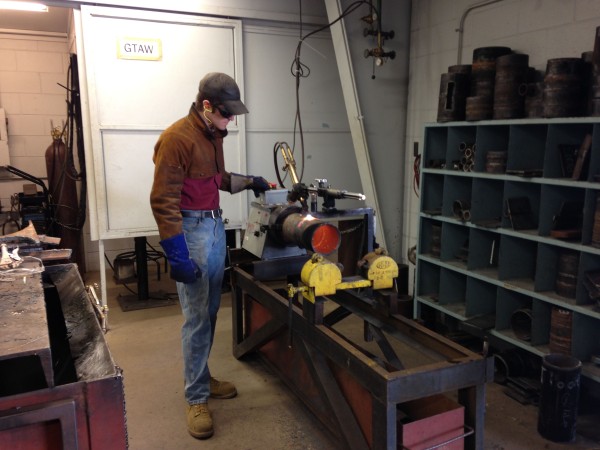
Irving-based Fluor Corporation plans to hire 500 welders in the next year for projects in Texas. Human Resources Executive Jim Hanna says in his 33 years at Fluor, he’s never seen this kind of demand.

“There really hadn’t been a reinvestment in the skill sets within the construction industry,” Hanna says. “And you couple that with the workforces that are at retirement age, and there’s a demand within the construction workforce to give people the skill sets to meet the future demands,”

Enrollment at trade schools across the state is on the rise. At Austin Community College, Majorie LaRowe enrolled more than 500 welding students at the Riverside Campus this semester.

“As many seats as we can offer, that’s how many we usually fill,” LaRowe says. “So, since we’ve been offering more seats, adding more sections each semester, we’ve been getting larger total enrollment numbers.” But LaRowe says ACC can’t add seats fast enough.

“We get constant calls and emails asking for more students that we can churn out really,” LaRowe says. “Right now there’s a large demand for pipe welders just south of us, we’ve gotten quite a few inquiries about that.”

Construction companies need welders so badly that they’ll hire them even before they’ve graduated. Twenty-eight year old Michael Reyes is in his third semester of school.

“I actually just got hired at Austin Water Jet,” Reyes says. “It’s a shop job and it’s a decent amount of money, it’s opened up a lot of doors for me and the experience I’m going to get there as well as getting here, it’ll pay off.”

He’s happy welding around the clock for school and for work.

“Quality of life is definitely there, having a reason to wake up, better outcome for what I want to do for a living, definitely have a family to support, two beautiful kids, they’re the reason why I’m doing this,” Reyes says.

His 27-year-old classmate Michael Morrin says it feels good to be in demand even before getting his associate’s degree.

“I went around applying and I had several people offered me a job on the spot, several people wanted to get back to me, I had to turn down the guys that wanted to get back to me,” Morrin says.

The paycheck is good too. “The rates are pushing up to 38, 40 dollars an hour because the demand is so great and there’s not enough qualified welders,” Hanna says. “I see this demand over the next seven to ten years, it’s easier for me to place a qualified welder today than someone with a four year degree.”

Hanna says you might see a momentary pause in pipeline construction due to low oil prices, but most of those contracts were commissioned long ago, meaning the welding boom might be here to stay.

In Southwest Houston, There Are More Sari Stores Than Starbucks

sari-store-e1426737016757

Get the full story on the Texas Standard

Farrah Akhtar says there’s no such thing as getting a quick sari.

“No, no, no, you want to try everything on, then you need the jewelry the shoes, and then you want to bargain and then you might not be happy with the deal, so you’ll go somewhere else,” Akhtar says.

Akhtar is a community manager for Yelp, and a sari store insider. Our first stop is Poshak, off of Interstate 69. Owner Anas Ahmed gives us the grand tour.

“Let me show you where my saris are kept,” Ahmed says. “So, the side you were on was our fabrics and shoes, this is our bridal and designer studio.”

There’s a few ways to buy a sari here: ready-to-wear, or you could pick out some vibrantly colored cloth and have it sent to their in-house tailor, or – if you have a couple hundred dollars burning a hole in your pocket – they’ll design one for you from scratch.

“The design process could take up to a week,” Ahmed says. “You basically sit down, you pick out your threads, you pick out your fabrics and we show you the thread and the work and the beading, and she sketches everything in front of you and you can see your patterns and you can actually see what you’re imagining, and then we move on forward from that.”

Poshak’s designer Sameera Faridi will travel to Pakistan to hand-deliver your order, where it will be hand died, sewn and beaded. Three months later, she’ll get back on a plane to pick it up.

Ahmed says business has really picked up since the store opened eight years ago. He says their clientele is as diverse as Houston.

“We have white people coming in all the time, and I wouldn’t just say white, we have multi-ethnicities, multi-religious,” Ahmed says. “We have Arabs coming in, we have Middle Eastern folks, we have people coming in from European also, and a lot of island people – because they have Indian heritage – who want to do a mix and match of all their color schemes,”

Poshak’s boutiquey specialization contrasts with Houston’s sari warehouses, which boast huge selections of ready-to-wear saris.

Roop Sari Palace is about the size of a Texas supermarket.

“This is all their stuff, massive, you could spend hours in here,” Akhtar says.

On a weekday lunch, about 40 women browse through the racks. This part of town was designated the Mahatma Gandhi District in 2010, and is known for its South Asian restaurants and sari shops.

“In the South, definitely there is very little competition in other states,” Ahmed says. “You go to Alabama, Louisiana even up to Atlanta, very few people have as many options as you would in Houston.”

“From here down you can stop by at least a dozen stores and they’re all loaded and they’re full.”

Ahmed says a lot of his customers buy outfits in Houston and then wear them in Pakistan.

Although Ahktar has never been to Pakistan, she says she loves a good sari.

“This is the traditional sari the three piece style that I love, I just think it’s so elegant,” Akhtar says while examining a bright blue and pink style.

She’s found a few saris that she likes here, but she’s not buying; sometimes the hardest part of buying a sari is finding the perfect event to match.