Two Bills That Could Affect Your Insurance Coverage

FEMA_-_44376_-_truck_windshield_with_hail_damage_in_OK-e1428370358551Get the full story on Texas Standard

Sometimes filing an insurance claim can seem like a staring contest. You versus your insurance company – and your insurance company has eye drops.

Anna Bohart’s office building was badly damaged in March 2012 – that’s when a record strong hailstorm hit McAllen.

“It looked like a tornado had come into the city, there were no leaves left on the trees, limbs had been broken, pets had been killed because of the hail,” Bohart says. “The buildings looked liked they had measles they had been so pockmarked with hail hitting the buildings.”

But Bohart says the real headache came when she started to file a claim with her insurance company.  “I had to call or email every day for 12 months practically,” Bohart says. It took public and private adjustors and dozens of phone calls before she got a check.

“It was terrible because you wanted to stay as nice as you could with someone who wasn’t cooperating or at least wasn’t answering, they would answer but they wouldn’t provide you with an answer,” Bohart says.

Attorney Mark Kincaid says some insurance companies make the process complicated because they want you to give up. “Insurance companies always have an economic incentive to deny the claim because they make more money that way,” says Kincaid.

But Senator Larry Taylor says he filed Senate Bill 1628 because fraudulent legislation is slowing the insurance industry down. “These is one of the issues if we allow it to keep going, the consumer is going to pay for it either through higher premiums or they’re going to lose coverages,” Taylor says.

Consumer advocates say the bill would make it almost impossible to sue your insurance company. “What would happen to consumers is they would be denied any effective remedy against insurance companies,” Kincaid says.

Senator Taylor says that’s just not true. “We’re not taking away people’s right to sue, I’m a big believer in the right to trial of your peers – if you have a legitimate complaint you should be allowed to take that to court,” Taylor says.

So will the bill pass? Alex Winslow with consumer protection group Texas Watch says if it does, you probably won’t even hear about it.

“Insurance is not an exciting topic, the insurance industry would like to use the fact that this is a dry topic in hopes that people won’t pay attention,” Winslow says.

Winslow says if the words “insurance”, “claims” and “lawsuits” make a lot of people’s eyes gloss over. The Senate bill is currently pending in commtitee and the House bill has not yet been heard.

Lobbyists Push Legislature to Open up Rules on Alcohol Sales

8372999205_66feea1880_k

Get the full story on the Texas Standard

Texas has a few laws surrounding alcohol: liquor stores are closed on Sundays,  you can’t put the American flag on beer bottles, and publicly traded companies can’t own liquor stores.

Travis Thomas says it’s only a matter of time before that last law is changed. He’s the spokesman for Texans For Consumer Freedom, a lobby that wants the law removed.

“To exclude public companies from competing is arbitrary, is anticompetitive and when you consider the fact that retail stores of all kinds all compete with publicly traded companies and they do not enjoy state-mandated protections,” Thomas says. “So then what is it that makes the retail liquor market different?”

Thomas says a public company doesn’t mean what it sounds like when it comes to the Texas Alcohol and Beverage Commission.

“According to TABC, a public company is one that has more than 35 shareholders,” Thomas says. “Now there are many, many companies that are not publicly traded that have more than 35 shareholders.”

Brookshires Grocery is the latest one of those publicly traded companies to join the Texans for Consumer Freedom, whose members include Costco, Walmart and the Texas Business Association. The lobby says it wants to amend existing state laws and has backed bills filed in the Texas House and Senate that would eliminate the prohibition on publicly traded companies.

Jason Isaac, R-Dripping Springs, filed one of those bills. He says that existing laws are against the principles of Texan’s belief in free market capitalism.

“We filed the bill, so we’re waiting on filing a request on the committee hearing,” Isaac says. “Once the bill goes through the committee hearing, we’re going to have testimony on both sides, and then you request a vote on the bill and then it goes to another committee called the calendars committee.”

Isaac says that he’s hopeful his bill will pass.

“Once they’re voted on the floor of the House, if they’re voted on favorably, it would go over to the senate.”

The bill has to pass those legislative hoops before it would change a law that’s been on the books since 1995—and the governor would still have to approve.

Texas Welders Are Getting Jobs Before They Graduate

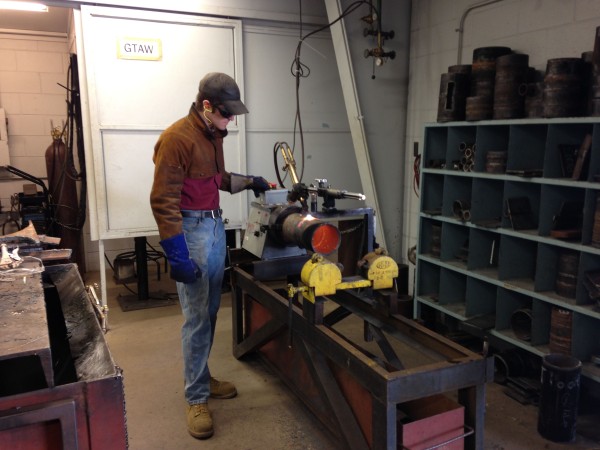
IMG_1131-e1427079009292Get the full story on the Texas Standard 

Irving-based Fluor Corporation plans to hire 500 welders in the next year for projects in Texas. Human Resources Executive Jim Hanna says in his 33 years at Fluor, he’s never seen this kind of demand.

“There really hadn’t been a reinvestment in the skill sets within the construction industry,” Hanna says. “And you couple that with the workforces that are at retirement age, and there’s a demand within the construction workforce to give people the skill sets to meet the future demands,”

Enrollment at trade schools across the state is on the rise. At Austin Community College, Majorie LaRowe enrolled more than 500 welding students at the Riverside Campus this semester.

“As many seats as we can offer, that’s how many we usually fill,” LaRowe says. “So, since we’ve been offering more seats, adding more sections each semester, we’ve been getting larger total enrollment numbers.” But LaRowe says ACC can’t add seats fast enough.

“We get constant calls and emails asking for more students that we can churn out really,” LaRowe says. “Right now there’s a large demand for pipe welders just south of us, we’ve gotten quite a few inquiries about that.”

Construction companies need welders so badly that they’ll hire them even before they’ve graduated. Twenty-eight year old Michael Reyes is in his third semester of school.

“I actually just got hired at Austin Water Jet,” Reyes says. “It’s a shop job and it’s a decent amount of money, it’s opened up a lot of doors for me and the experience I’m going to get there as well as getting here, it’ll pay off.”

He’s happy welding around the clock for school and for work.

“Quality of life is definitely there, having a reason to wake up, better outcome for what I want to do for a living, definitely have a family to support, two beautiful kids, they’re the reason why I’m doing this,” Reyes says.

His 27-year-old classmate Michael Morrin says it feels good to be in demand even before getting his associate’s degree.

“I went around applying and I had several people offered me a job on the spot, several people wanted to get back to me, I had to turn down the guys that wanted to get back to me,” Morrin says.

The paycheck is good too. “The rates are pushing up to 38, 40 dollars an hour because the demand is so great and there’s not enough qualified welders,” Hanna says. “I see this demand over the next seven to ten years, it’s easier for me to place a qualified welder today than someone with a four year degree.”

Hanna says you might see a momentary pause in pipeline construction due to low oil prices, but most of those contracts were commissioned long ago, meaning the welding boom might be here to stay.

In Southwest Houston, There Are More Sari Stores Than Starbucks

sari-store-e1426737016757

Get the full story on the Texas Standard

Farrah Akhtar says there’s no such thing as getting a quick sari.

“No, no, no, you want to try everything on, then you need the jewelry the shoes, and then you want to bargain and then you might not be happy with the deal, so you’ll go somewhere else,” Akhtar says.

Akhtar is a community manager for Yelp, and a sari store insider. Our first stop is Poshak, off of Interstate 69. Owner Anas Ahmed gives us the grand tour.

“Let me show you where my saris are kept,” Ahmed says. “So, the side you were on was our fabrics and shoes, this is our bridal and designer studio.”

There’s a few ways to buy a sari here: ready-to-wear, or you could pick out some vibrantly colored cloth and have it sent to their in-house tailor, or – if you have a couple hundred dollars burning a hole in your pocket – they’ll design one for you from scratch.

“The design process could take up to a week,” Ahmed says. “You basically sit down, you pick out your threads, you pick out your fabrics and we show you the thread and the work and the beading, and she sketches everything in front of you and you can see your patterns and you can actually see what you’re imagining, and then we move on forward from that.”

Poshak’s designer Sameera Faridi will travel to Pakistan to hand-deliver your order, where it will be hand died, sewn and beaded. Three months later, she’ll get back on a plane to pick it up.

Ahmed says business has really picked up since the store opened eight years ago. He says their clientele is as diverse as Houston.

“We have white people coming in all the time, and I wouldn’t just say white, we have multi-ethnicities, multi-religious,” Ahmed says. “We have Arabs coming in, we have Middle Eastern folks, we have people coming in from European also, and a lot of island people – because they have Indian heritage – who want to do a mix and match of all their color schemes,”

Poshak’s boutiquey specialization contrasts with Houston’s sari warehouses, which boast huge selections of ready-to-wear saris.

Roop Sari Palace is about the size of a Texas supermarket.

“This is all their stuff, massive, you could spend hours in here,” Akhtar says.

On a weekday lunch, about 40 women browse through the racks. This part of town was designated the Mahatma Gandhi District in 2010, and is known for its South Asian restaurants and sari shops.

“In the South, definitely there is very little competition in other states,” Ahmed says. “You go to Alabama, Louisiana even up to Atlanta, very few people have as many options as you would in Houston.”

“From here down you can stop by at least a dozen stores and they’re all loaded and they’re full.”

Ahmed says a lot of his customers buy outfits in Houston and then wear them in Pakistan.

Although Ahktar has never been to Pakistan, she says she loves a good sari.

“This is the traditional sari the three piece style that I love, I just think it’s so elegant,” Akhtar says while examining a bright blue and pink style.

She’s found a few saris that she likes here, but she’s not buying; sometimes the hardest part of buying a sari is finding the perfect event to match.

This Ain’t Greyhound: The Luxury Bus That’s a Texas Alternative to Rail

img17-1Get the full story on the Texas Standard

More than 200,000 super-commuters make the trek between Houston, Austin and Dallas every week. Doing that by air or behind the wheel can be a major hassle. Marjorie Kimmel knows first-hand. She travels around Texas once a month to teach real estate courses.

“I tried a little bit of everything, most of the time I was a road warrior, gripping the steering wheel on 1-35 the whole time,” Kimmel says. “I also tried flying once which was a real pain because I have a lot of books and equipment when I teach, and so trying to get that shipped ahead of me to then fly took a lot of logistical planning.”

Limos can be expensive. Executives like Marjorie Kimmel don’t always see the bus as a possibility. “That’s not probably something I would have done, just because I would have felt pretty cramped and you know, I don’t know, it’s never even occurred to me,” says Kimmel.

But Kimmel is exactly the type of business traveler that Alex Danza had in mind when he started his luxury bus service, Vonlane.

“The idea for this was give people an alternative to that hassle experience of flying and the alternative of driving themselves wasn’t much better,” Danza says, “so what we’re trying to do is to give people a real first-class travel experience where they can arrive 5 minutes before departure, they get on board, they can start to work right away, they can relax, they have an attendant taking care of them, they have great amenities from complimentary wi-fi to satellite TV, satellite radio, food and beverages.”

Danza isn’t trying to compete against Grayhound or Megabus – Because he says Vonlane isn’t a bus, it’s a motor coach for executives. “Our rate is 100 dollars one way and we’re priced very competitively with flying Southwest airlines or driving your own vehicle,” Danza says.

Danza says a lot of his customers are lawyers – because riding his bus provides them 3 uninterrupted billable hours. So far, business is pretty good. Danza says the only real competition he sees is far into the future.

“I do think there’s a demand for rail, people ask me if that concerns me, I think it’s a long ways away if it can happen, but we’re definitely seeing people looking for an alternative to self-drive or the airlines,” Danza says.

A company named Texas Central Railway plans to use private investment and Japanese technology to run a bullet train between Dallas and Houston. Travis Kelly says the demand for rail is much greater than just the number of passengers on executive motor coaches.

It’s a lot of people who are making the trip now, but it’s also people who choose not to make the trip at all because to travel by air or by car is too onerous, too difficult, too unpredictable,” Kelly says.

Commuter Marjorie Kimmel says she’s ready for rail. “If they had a high speed rail system like they do in Europe from Austin to Dallas, heck yeah, I’d be the first to sign up!”

But the reality of rail is still a couple of years way.

“We hope to proceed to construction as early at the first quarter of 2017 and that would allow trains to start running in 2021 or 2022,” Kelly says.

High speed rail would cut the road commute time in half – just 90 minutes to travel from Houston to Dallas. Even in the fanciest motorcoach, it’s going take you 3 and half hours to get there.

In the meantime Danza says, at least in a bus, you’re not behind the wheel.“We get comments that say ‘I’ll never drive myself to Dallas again’, ‘I’ll never fly to Austin again’, and we’re seeing that repeatedly so it’s been very interesting to see that there is a marketplace for this,” Danza says.

The more miserable you are at security checkpoints or stuck behind an 18 wheeler on 1-35, the better for Danza’s business model – at least until you can board a bullet train.

Job Growth Spurs Temporary Housing Market In Houston

6-exterior-e1425954687996Get the full story on the Texas Standard 


Imagine waking up in your luxury apartment. There’s a knock at the door – in wheels some scrambled eggs, bacon, toast, a gourmet breakfast delivered. Every morning.

And your company’s paying for all of it.

That could be the reality for some Houston transplants — as early as June. If David Redfern has his way. He’s the president of Waterwalk.

“Waterwalk specifically is one part apartment, one part corporate housing and one part upscale extended stay hotel,” Redfern says.

While anyone who can afford the base rent of $2,ooo a month is welcome, Redfern has one specific customer in mind.

“Our customer is the people that are traveling for those types of business trips and so that tends to be companies that have relocations, trainings and projects,” Redfern says.

Houston added more than 100,000 jobs in the last 12 months and hosted more than 4 million business travelers. Forty-one percent of those jobs were in the energy and healthcare fields.

Relocation specialist and writer Michelle Sandlin says all those business travelers need a place to stay.

“Houston has a lot of temporary housing providers offering various products and there’s always been, for the last few years, an inventory shortage in that regard,” Sandlin says.

“So, I would imagine anybody coming into that market offering this type of product and service would certainly be welcome in the community.”

More than 5,000 energy-related firms in Houston compete for some of the best talent in the country. And when you’re trying to woo someone to your team, every little luxury counts.

“We deliver breakfast to each room, each apartment, we provide obviously housekeeping, we have a car service that will take people wherever they need to go,” Redfern says.

“It’s kind of a level of pampering you don’t get these days.”

Once the Houston property is up and running, Waterwalk plans on expanding to Austin, San Antonio and Dallas/Fort Worth.

“Well, Houston has had and Texas has had a steady influx of people moving here for several years, we’ve got population growth that continues to surge,” Sandlin says.

The state demographer says the Texan population will double by 2050. Part of that is projected birth rates, and part is people from all over the world moving here to work. Companies who can ease that transition for new Texas residents look at the statistics and see dollar signs.
 

Texas Is A Leader In The Video Game Industry

Tex_playing_video_games-e1425908416997Get the full story on the Texas Standard

The Texas video game industry directly employs about 5,000 people. It also creates hundreds more jobs that depend on transporting and selling the technology.

Dallas, San Antonio and Austin are the hubs of innovation. Big games like “Call of Duty” and “World of Warcraft” came from Texas game studios: Aspyr and Blizzard.

But gaming isn’t just about gaming anymore.

Jennifer Bullard directs the two year-old Captivate Conference for professionals in the gaming industry. “The game industry is pretty wide and diversified – there’s console developers, there’s mobile developers, there’s education game development here, there’s people who work in what we call real-world games, training simulations,” she says.

Bullard has been designing games like “Heroes of Might & Magic” and “The Amazing Spider-Man 2” for 17 years. She says the country’s second biggest gaming industry is always hunting for new recruits.

“There’s more education institutions for game development,” Bullard says. “When I first got started people didn’t even have bachelor’s degrees and frankly didn’t care about it. Now, of course, if you want to get into the game industry you need a bachelor’s degree.”

 Texas universities are stepping up to keep the industry supplied. Campuses from Abilene to Victoria have established gaming departments. At UT-Dallas there’s the Center for Modeling and Simulation. Marge Zielke is the director.

Director Marge Zielke says the program “emphasizes 21st century media as an extension of its degree plan.” The curriculum is based on critical thinking, research projects, and learning how to appeal to a wide audience.

“One of the things that we try to teach students in all of our classes is that it’s one thing to be able to use the technology that we have available to us today,” Zielke says, “but students of media really have to think about how to conceptualize and develop media that doesn’t exist yet.”

Some of that conceptualizing is likely to take place at next month’s SXSW. Developers, manufacturers and fans from all over the country will show off their stuff at the SXSW Gaming expo next week. No matter what happens, you can be sure the next big thing in gaming will be revealed in Texas.

Tortillas: The Hot Food Trend 500 Years in the Making

IMG_0017-e1425566821732Get the full story on the Texas Standard

When Chef Jorge Rojo learned that Food And Wine Magazine had named homemade tortillas a trend to watch in 2015, he scoffed.

“Tortilla? A Trend? Really? Well in Mexico the Trend has been for hundred for years, and it hasn’t been a trend,” Rojo says.

Aztec women were already making tortillas in 1515 – before Cortez even arrived.

Turns out – in 2015 — store-bought tortillas are more popular than ever. The Tortilla Industry Council reported 12 billion dollars in sales in 2012. And the flour versions edged out corn by about 120 million.

Alma Ramirez understands why tortillas are so popular in stores. I caught her on her shift at the Del Rio Tortilla factory in south San Antonio. She says that even though she spends all day making tortillas, when she cooks at home, she uses store-bought.

“You get home late from work and you’re tired, you go get your kids and you stop by the store to get your tortillitas,” Ramirez says.

You see-even though they look simple, tortillas are really hard to make.

Chef Jorge Rojo’s restaurant is attached to the Sanitary Tortilla Company in San Antonio. The corn grinding and the masa-making start way before sundown every day. By noon most days, they’re all sold out.

“It’s a long process that you have to make every day, so we grind our own mixtamal, which is the cooked corn,” Rojo says, “so they make them in several ways, we make corn chips, tostadas, taco shells, tortillas, all you can do with corn.”

But Rojo says there’s a big difference between the hand made tortilla versus the machine made version at the supermarket.

“When you do those by hand it’s considerably different, it’s more fluffy, they cook at the same time, it’s more convenient to reheat them, because they’re more soft, and it has a longer shelf life,” Rojo says.

So maybe it’s not that homemade tortillas are a “trend,” it’s that the American consumer is becoming more discerning.

Natalie Boites says if a restaurant “didn’t have homemade flour of corn tortillas I wouldn’t go back.”

Alma Ramirez agrees. She says store-bought tortillas are fine when you’re making yourself a late-night quesadilla. But if you’re going to buy your meal, even if it’s from a side-of-the-road taco cart, you want those tortillas to be fresh.

A  note here to Food and Wine editors:  calling something a trend, implies it’s a fad. Here today, gone tomorrow.  In Texas,  tortillas aren’t a trend, they’re a tradition.

Texas Institutions Take A Bite Out Of Student Debt

4222474443_a5e2ebaabeGet the full story on the Texas Standard

In 2003, The Texas Legislature voted to allow public universities to set their own tuition. Since then, tuition has more than doubled and student debt in Texas has skyrocketed.

State Senator Charles Schwertner filed a bill to cap tuition and fees at the state’s public colleges and universities at their current levels. Under the bill they would only be allowed to grow at the rate of inflation. But this bill hasn’t yet come to a vote, and there’s no indication of whether that will happen.

Lauren Asher with the Project on Student Debt says that Texas is doing relatively well compared to the rest of the nation.

“Texas had lower than average than debt compared to the national, it had the 32nd highest and was 28th for the share of students with loans,” Asher says.

But one of the reasons why student debt is relatively low is because Texas has a higher share of students who graduate from community colleges, which tend to be much cheaper. Among students who go to 4 year colleges, debt is still a big problem. Texas is among the top states with the highest default rate on federal student loans.

Right now a lot of students rely on Federal Pell Grants, which are about $5 thousand dollars a year. But when you add in not just tuition but housing, food and books, that just makes a dent in what it costs to go to college.

Which is why two Texas institutions are tackling student debt in their own ways. Memorial Herman, one of the biggest hospital systems in Texas, made an announcement saying that on July 1st they’ll start paying off their employee’s student loans. Ann Hollingsworth is an HR executive there.

”We’ve long had a tuition reimbursement program for people who are currently going to school but we didn’t have anything for people who had gone through school and finished who were struggling with debt,” Hollingsworth says. “We thought, well what can we do to help the people that have just graduated who won’t be going to school anymore, but who are still paying for their education.”

The healthcare field is so competitive in Houston that it just might catch on. But there’s another novel idea in the works. Michael Sorrell is the president of Paul Quinn College, an HBCU south of Dallas. The small liberal arts college is now becoming a work college to make school more affordable for students.

“Being a work college means that every student that lives on campus is required to have a job, probably the simplest way to explain is work study on steroids,” Sorrell says.

Students can perform any job on campus, from administrative positions to groundskeeping. Sorrell says that by basically having students run the school they’ll dramatically cut costs. Between Pell Grants and scholarships, he’s vowing that no student will graduate with more than $10,000 in debt. That’s less than half the state average. 

The Big Fight in Galveston Bay Over Oysters

imagesGet the full story on the Texas Standard

A local  district gave a private company exclusive rights to harvest oysters over 23,000 acres. Opponents say that deal wasn’t legal – and they have Texas Parks & Wildlife backing them up.

There’s one thing you need to know about oysters: they’re crucial to the ecosystem in Galveston Bay.

Tom Harvey, a spokesman for Texas Parks and Wildlife, says the agency has a vested interest in restoring the oyster beds that were damaged during Hurricane Ike.

“They’re filter feeders which means they naturally clean contaminants over the water,” Harvey says.

Clean water is good for business. Oysters are a $3 billion industry in Texas. Add in recreation, tourism and other businesses that rely on clear gulf water, and it’s closer to $20 billion.

Who’s in Charge?

Texas Parks and Wildlife regulates bay bottoms, where oysters grow. It grants permits to oystermen, who then follow its recommendations on how many oysters to harvest, when and how.

50 years ago the Chambers Liberty Council Navigation District bought a 23,000 acre strip on the Galveston Bay.

A couple of months ago, Tracy Woody had an idea: what if he leased the bay for his oyster business?

His lawyers talked to their lawyers, and they worked out a deal. Woody paid $1.50 per acre for the exclusive rights to harvest oysters in the area for 30 years.

Mary Beth Stengler is the navigation district’s general manager. She says the district has made all sorts of leases before, primarily for pipelines and restoration projects, “so [they’re] under good faith that [they] can do this lease with no problem.”

Woody says he’ll let other oyster companies use the bay, if he gets a cut of their profits – he is a businessman, after all.

What’s the problem?

The Texas Parks and Wildlife Department says this whole deal was illegal – the navigation district doesn’t have the legal authority to lease the bay for commercial activity.

“The navigation district lacked the legal authority to enter into a lease that would exclude current oyster leaseholders,” Harvey says. “Meaning those people that our agency had issued certificates of location, or the public who wanted to go fishing in that area.”

A Texas Showdown

Woody says he’s ready to make his case in court.

“If the agency doesn’t want to recognize the law and we still firmly believe that we have a right to do this and nobody has proven otherwise then we’re going to go to court,” Woody says. “That’s what courts are for.”

Texas Parks and Wildlife isn’t backing down either.

“We remain open to any type of reasonable discussion,” Harvey says. “We certainly prefer to have an amicable resolution to this matter where every party as much as possible can get what they want.”

Other Gulf oyster companies are also weighing in. Lisa Halili owns Prestige Oysters.

“It’s a money grab, it’s self-centered, it’s for profit, it’s not for the good of the people,” Halili says.

She and other oyster company owners don’t have faith that this fight will be settled anytime soon. So they’re taking the matter up with lawmakers. They want it to be crystal clear that navigation districts can’t lease public resources for commercial activity.

“It’s very simple. The bay, the state water bottom, the beautiful bay that your parents take you boating on, that is a public resource, that means it belongs to all of us to share,” Halili says.

So far, no lawmaker has taken the bait. At least not publicly.